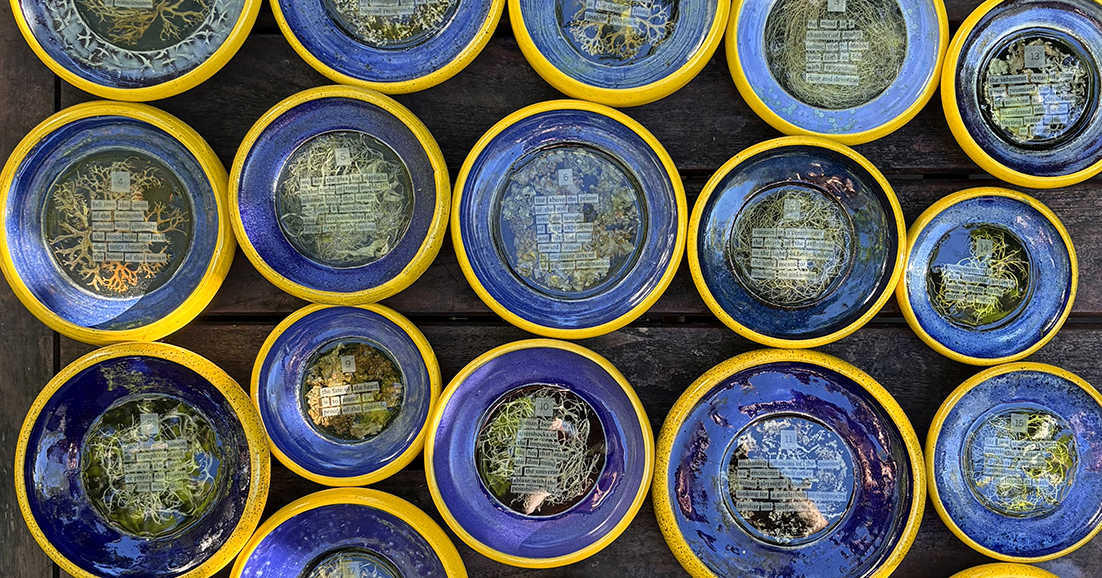
We place life’s bets by countless calculations of probability, conscious and unconscious, only to discover over and over how short they fall of the wildest reaches of the possible, which always includes but exceeds the probable. It helps to remember that we ourselves are children of improbability, that everything we treasure exists not because it had to, not because it was likely or necessary, but because the universe took a gamble against the staggering odds otherwise.

 THE WILDEST BET IS THE WINNING BET
by Maria Popova
You wouldn’t have bet on it,
the battered rock
orbiting a star
from the discount bin
of the universe,
wouldn’t have guessed
that it would bloom
mitochondria and music,
that it would mushroom
mountains and minds,
and the hummingbird wing
whirring a hundred times faster
than your eye can blink,
and your eye that took
five hundred million years
from trilobite to telescope,
and the unhurried orange lichen
growing on the black boulder
two hundred times more slowly
than the tectonic plates beneath
are drifting apart
and the marbled orca
carrying her dead calf
down the entire edge
of the continent,
carrying the weight
of consciousness
and consciousness
how it windows
this tenement
of breath and bone
with wonder,
how it hovers over everything,
gigantic and unnecessary,
like music,
like love.
My brightest gratitude to Nick Cave for the soulful reading and to Brazilian artist Daniel Bruson for the breathtaking animation, and to both of them for the ongoing collaboration that began with “But We Had Music.”
In 1824, studying a set of large fossil bones discovered in a quarry near Oxford two centuries earlier, the English theologian, geologist, and paleontologist William Buckland kept looking at the fragment of the lower jaw. Something didn’t add up. As he examined it more closely, he realized these were not the remains of an elephant, as previously thought, but of an enormous carnivorous reptile with no analogue in the fossil record or in the living world.
He christened it Megalosaurus — the first named dinosaur — and set out to compose a complete account of the ancient beast.
Because nobody knew what dinosaurs looked like, he needed an exceptional scientific illustrator whose unbridled imagination and disciplined draughtsmanship could enflesh the bones of the mysterious creature. Taken by a particularly excellent drawing of the jaw of an extinct hyena, he obtained a letter of introduction to the artist, tucked it into his coat pocket, and boarded a coach across Devonshire, hoping to be received.
William took one book to accompany him on the long ride — a weighty new volume by paleontology founding father Georges Couvier, summarizing his pioneering research on the fossil bones of quadrupeds. With gaping disbelief, he watched another passenger take out that same book and begin paging through it. The conversation was inevitable and the realization quick: She was the artist he was traveling to meet. Cuvier himself had sent her the book in gratitude for her contribution.

Mary Morland’s watercolor of hyaena jaw, 1822. (The Royal Society)
Perhaps because she had lost her mother while still an infant, Mary Morland had grown up fascinated by deep time, by the slow-burning beauty of minerals, by the way fossils immortalized the ephemerality of the flesh. After devouring Couvier’s books as a teenager, she taught herself draughtsmanship and unlearned what her culture had told her she could be: Determined to become an artist of science, she sent her specimen illustrations to Couvier himself.
The venerable scientist was so taken with the young woman’s work that he published it alongside his studies. Word spread across the scientific community and soon she was illustrating other books and modeling rare specimens in leather.

Miniature of Mary Morland circa 1840. (Oxford University Museum of Natural History)
Unlike most women of her time, whose standard path to subsistence was marriage, Mary could now make a living by her own work. If she married, it would only be for love. Her love was the science of time: She kept drawing paleontological specimens, grew an impressive mineral collection, became a fossil geologist herself.
By the time she met William that day on the coach, she was an old maid in her late twenties and one of the era’s most esteemed scientific illustrators. They started on the dinosaur work immediately.

Lithograph of Megalosaurus jaw specimen after Mary Morland, 1824. (Oxford University Museum of Natural History)
Within a year, Mary Morland was Mary Buckland. Their home became a miniature Alexandria of science books, light pouring in from candle-holders made of ichthyosaurus vertebrae, fossils lining every sideboard. Their dining room housed a menagerie of frogs and snakes. Guinea pigs ran regularly across the table. A pony occasionally rode past, a laughing child on its back.
One of their surviving children would later recount that Mary not only illustrated William’s studies but, with her “great mental powers, habits of perseverance and order, tempered by excellent judgment,” she “gave to them a polish which added not a little to their merit.”

Silhouettes of the Bucklands collaborating as their young son plays with a fossil under the worktable. (The Life and Correspondence of William Buckland, 1894)
Despite their fourteen-year age difference, she outlived him by just over a year, channeling her bereavement in studying marine bryozoans — coral-like saltwater creatures — with her daughter. Hours before her death, Mary was still bent over her microscope, entranced by a new specimen.
Mary and William were buried alongside one another, their entwined fossils to be discovered by some paleontologist of the far future: What is love if not the mutual belonging of our passions and our bones.

Our lives are defined not by what we have but what we give — on what and whom we spend our energy and time, how we share our material possessions and our mental powers, what we do with our gifts. “Anything you do not give freely and abundantly becomes lost to you,” Annie Dillard wrote in contemplating the nature of creativity. “You open your safe and find ashes.”
Paradoxically, the ability to give hinges on the ability to receive: You must be rested in order to labor, taking the repose it takes to recharge your vital energies; you must be interested in order to be interesting, taking the world in with a greedy curiosity that absorbs its beauty and strangeness in order to metabolize it into meaning.
C.S. Lewis (November 29, 1898–November 22, 1963) offers a wonderfully counterintuitive perspective on our notions of generosity and our ideas about what it means to be interesting in his memoir Surprised by Joy (public library).

C.S. Lewis
With an eye to the ideal structure of the creative life, he writes:
It is a life almost entirely selfish. Selfish, not self-centred: for in such a life my mind would be directed towards a thousand things, not one of which is myself. The distinction is not unimportant. One of the happiest men and most pleasing companions I have ever known was intensely selfish. On the other hand I have known people capable of real sacrifice whose lives were nevertheless a misery to themselves and to others, because self-concern and self-pity filled all their thoughts. Either condition will destroy the soul in the end. But till the end, give me the man who takes the best of everything (even at my expense) and then talks of other things, rather than the man who serves me and talks of himself, and whose very kindnesses are a continual reproach, a continual demand for pity, gratitude, and admiration.
This is also why, Lewis intimates, the “thrill” of our greatest creative breakthroughs — those revelations that give us back to ourselves, out of which we give our best work to the world — is rooted in “self-forgetfulness”:
Only when your whole attention and desire are fixed on something else — whether a distant mountain, or the past, or the gods of Asgard — does the “thrill” arise.
[…]
Shut your mouth; open your eyes and ears. Take in what is there.
Couple with John Steinbeck on the art of receiving, then revisit C.S. Lewis on what we long for in our existential longing.


 Hello Blog! This is the weekly email digest of