|
|
 Hello Blog! This is the weekly email digest of The Marginalian by Maria Popova. If you missed last week's edition — how to speak forest, how to fall in love better, and a live celebration of wonder — you can catch up right here. And if my labor of love touches your life in a meaningful way, please consider supporting its ongoingness with a donation — for twenty years, it has remained free, ad-free, AI-free, fully human and alive thanks to reader patronage. If you already donate: I appreciate you more than you know. Hello Blog! This is the weekly email digest of The Marginalian by Maria Popova. If you missed last week's edition — how to speak forest, how to fall in love better, and a live celebration of wonder — you can catch up right here. And if my labor of love touches your life in a meaningful way, please consider supporting its ongoingness with a donation — for twenty years, it has remained free, ad-free, AI-free, fully human and alive thanks to reader patronage. If you already donate: I appreciate you more than you know.
|
It started with an urn for living gone wrong, the clay kiltering off center, resisting my every effort to force it back into shape. The harder I pushed to control it, the more it took on a life of its own, folding like flesh, bending like mind. I pushed and despaired, pushed and despaired, until, exhausted and exasperated, I gave up and simply let my hands follow the momentum of the clay, saying “YES” to its will.
And then, magic: I watched the vessel turn into what I could have never imagined, never created by force: an enormous seashell, a miniature Guggenheim, a great open ear — asymmetrical yet perfect in its secret logic, the proof beyond the postulate.

Here was an antidote to all the urns and bowls I had controlled into perfect symmetry, almost factory-like, pushing so hard to center that a stress injury incapacitated my left arm for seven months. Here was a hard, fragile material — pulverized stone that vitrifies like glass — taking a soft, organic shape.
I found myself wondering what life itself would be like if, rather than willing it to conform to our design only to end up in despair, we simply said “YES” to its will, collaborating with rather than resisting the centrifugal force of the heart, the angular momentum of memory, the gravity of change. “YES” to the necessary losses. “YES” to the fear that signals growth. “YES” to the death of the dream of perfection.
“The great difficulty is to say Yes to life,” James Baldwin observed in reckoning with the paradox of freedom not long after Viktor Frankl looked back on surviving the Holocaust to insist that our task here is to say “yes to life in spite of everything.”
Beyond basic physical survival, most of our psychological suffering, when closely examined, is a form of saying “NO” to life — a refusal, vehement or subtle, to bend the idea of how things should be to the raw reality of how they are, the reality that is the only arena in which we can act to change anything. All things not pliant enough to bend will break — fragility is a function of rigidity.
We contact this elemental law most clearly and most painfully in relationships, which have a will of their own greater than the sum of two intents and which are never, however reciprocal, perfectly symmetrical. Have too rigid an idea of what a relationship should be, and it will inevitably shatter; look back on the most enduring and rewarding relationships of your life, and you will discover that they have found their own right form, different from your first intent, a form that is never final.
And yet, paradoxically, rupture and repair are how relationships are stress-tested and fortified across the long horizon of life. In this regard, love is more like embroidery than like pottery — you make a hole to make a stitch.

So began a daily practice of collaborating with rather than forcing the clay, then embroidering the result — vessels to hold a life that says “YES” to itself, a life needful of constant reminding that all things forced are false and fragile. We need these reminders, all of us, if we are to be true to our own hearts.


And so, as with my other ceramics, I am letting the impartial hand of chance, which forces nothing yet shapes everything, give a dozen of these vessels — yessels? — away: To enter the raffle, make a donation by November 30 in any amount that feels unforced for you, so long as you end it with the decimal .12, whether it is $1.12 or $1,000.12. (For greater odds, consider joining my twentieth anniversary celebration — another set will be raffled off at the Museum of Delight there.)

And because the hand and the mind, the body and the spirit, are in constant conversation, somewhere along the way of this reckoning with life in clay and thread, a poem wrote itself in me:
 VESPER FOR A BURNING WORLD VESPER FOR A BURNING WORLD
by Maria Popova
You need not be a saint,
stripped bare of all desire,
or a savior,
dragging the drowning
out of their pain
by the regret-stained collar
of their discontent.
You need not leaven
the world’s heavy toll of hope
by propping the sky up
with your sunburnt hands
or fence yourself off
in the flowerless meadow
of detachment.
All you need to do
is look in the mirror of morning
and say “Yes.”
donating=lovingEvery month, I spend hundreds of hours and thousands of dollars keeping The Marginalian going. For twenty years, it has remained free, ad-free, AI-free, fully human and alive thanks to patronage from readers. I have no staff, no interns, not even an assistant — a thoroughly one-woman labor of love that is also my life and my livelihood. If it makes your own life more livable in any way, please consider aiding its sustenance with a one-time or loyal donation. Your support makes all the difference.
monthly donationYou can become a Sustaining Patron with a recurring monthly donation of your choosing, between a cup of tea and a Brooklyn lunch. |
|
one-time donationOr you can become a Spontaneous Supporter with a one-time donation in any amount. |
 |
|
 |
|
| Partial to Bitcoin? You can beam some bit-love my way: 197usDS6AsL9wDKxtGM6xaWjmR5ejgqem7 Need to cancel an existing donation? (It's okay — life changes course. I treasure your kindness and appreciate your support for as long as it lasted.) You can do so on this page. |
|

There are, in my experience, two fundaments of the creative life: putting yourself regularly in the path of wonder and getting out of your own way in order to receive what you encounter there.
Wonder, like enchantment, is not something you can control or plan for or will — it is something that befalls you, overcomes you, pours upon you spontaneous and unbidden. Paradoxically, what makes such spontaneity possible is structure — an organizing principle for the hours of the day that makes room, and reserves it, for these moments of magic. This is not simple to configure and not easy to enact: How to spend our hours and shape our days may be the supreme problem of human life. There is no permanent, perfect, or universal solution, for the problem is laced with our particularity — but we can learn from each other, borrow bits and pieces from various approaches, constellate a singular organizing principle from different points of light.
Among the finest I have encountered, in being both pragmatic and profound, is the one C.S. Lewis (November 29, 1898–November 22, 1963) offers in his memoir Surprised by Joy (public library). 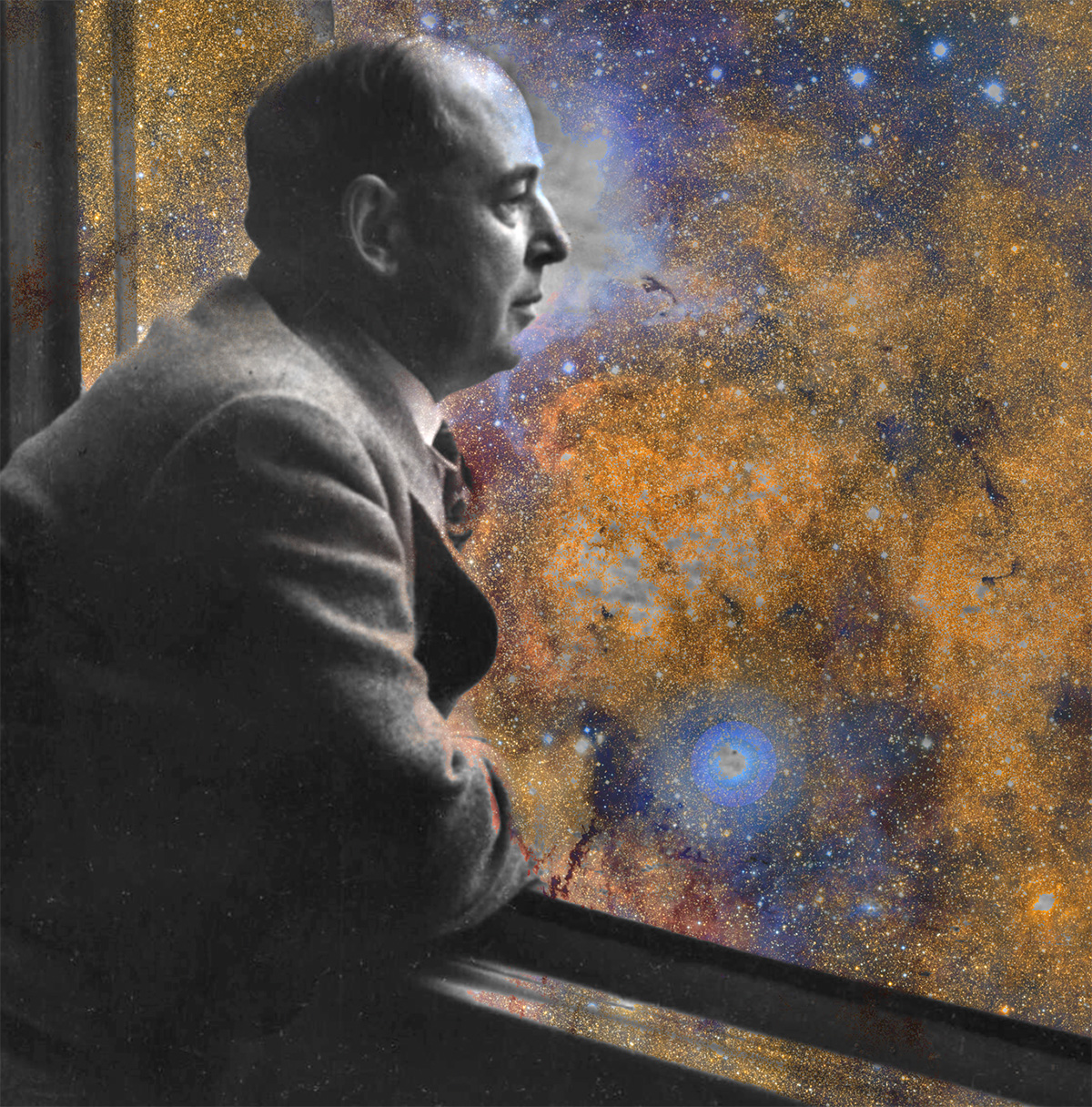
C.S. Lewis
Looking back on a period of especial creative fertility and focus — one in which The Chronicles of Narnia began germinating — he details the deliberate structure of his days:
I would choose always to breakfast at exactly eight and to be at my desk by nine, there to read or write till one. If a cup of good tea or coffee could be brought me about eleven, so much the better… At one precisely lunch should be on the table; and by two at the latest I would be on the road. Not, except at rare intervals, with a friend.
Echoing mountaineer and poet Nan Shepherd’s insight about what makes an ideal walking companion, he adds:
Walking and talking are two very great pleasures, but it is a mistake to combine them. Our own noise blots out the sounds and silences of the outdoor world… The only friend to walk with is one… who so exactly shares your taste for each mood of the countryside that a glance, a halt, or at most a nudge, is enough to assure us that the pleasure is shared.
Every visionary is equal parts proprietor of a way of seeing unlike any other in the entire history and future of the universe, and product of their time and place. For all his originality and daring, Lewis — born in the final years of the nineteenth century, forged in the crucible of proper Englishness — was still touchingly a product of his culture:
The return from the walk, and the arrival of tea, should be exactly coincident, and not later than a quarter past four. Tea should be taken in solitude.
Tea comes with a light meal. Observing that, unlike walking and talking, “eating and reading are two pleasures that combine admirably,” he recounts always dining with a book — though not all books would do. “It would be a kind of blasphemy to read poetry at table,” he admonishes. Read, instead, “a gossipy, formless book which can be opened anywhere.” To us, the whole of the Internet may be one such gossipy, formless scroll. To Lewis, it meant books like Tristram Shandy and Anatomy of Melancholy.
And then, at five, back to work until seven, concluding the day in a manner that would make Andrew Huberman proud:
Then, at the evening meal and after, comes the time for talk, or, failing that, for lighter reading; and unless you are making a night of it with your cronies… there is no reason why you should ever be in bed later than eleven.

Art by Lisk Feng from There Was a Shadow by Bruce Handy
In a passage of especial poignancy in our own time, when the modes and demands of correspondence have proliferated to a tyrannical degree, he adds a primary parameter that holds the entire structure together:
It is an essential of the happy life that a man would have almost no mail and never dread the postman’s knock. In those blessed days I received, and answered, only two letters a week; one from my father, which was a matter of duty, and one from [my best friend] Arthur, which was the high light of the week, for we poured out to each other on paper all the delight that was intoxicating us both.
All of this structure, all of this protection from intrusion, is in the service of one thing only — training the imagination to receive the signal of life, the signal of which all of our creative work is a translation. A century before science illuminated how the natural world fuels creativity, Lewis saw a parallel between our encounters with nature and with the muse. He offers a timeless instruction for how to face the forest or the blank page, the cosmos or the canvas:
Total surrender is the first step… Shut your mouth; open your eyes and ears. Take in what is there and give no thought to what might have been there or what is somewhere else.
Complement with George Kubler on how to hear the signal of your life and Hermann Hesse on wonder and the proper aim of education, then revisit C.S. Lewis on what we long for in our existential longing.
donating=lovingEvery month, I spend hundreds of hours and thousands of dollars keeping The Marginalian going. For twenty years, it has remained free, ad-free, AI-free, fully human and alive thanks to patronage from readers. I have no staff, no interns, not even an assistant — a thoroughly one-woman labor of love that is also my life and my livelihood. If it makes your own life more livable in any way, please consider aiding its sustenance with a one-time or loyal donation. Your support makes all the difference.
monthly donationYou can become a Sustaining Patron with a recurring monthly donation of your choosing, between a cup of tea and a Brooklyn lunch. |
|
one-time donationOr you can become a Spontaneous Supporter with a one-time donation in any amount. |
|
|
|
|
| Partial to Bitcoin? You can beam some bit-love my way: 197usDS6AsL9wDKxtGM6xaWjmR5ejgqem7 Need to cancel an existing donation? (It's okay — life changes course. I treasure your kindness and appreciate your support for as long as it lasted.) You can do so on this page. |
|

Here we are, bewildered miracles of chemistry and chance, trembling embers of dead stars capable of sign and song, a wild bet against probability that won.
We have dreamt up origin myths and cosmological models, built the Taj Mahal and the Large Hadron Collider, to fathom where we came from and where we are going. We have invented mathematics to describe the mystery we live in and poetry to describe the mystery we are. But beneath it all, we are born knowing — though we spend our lives unlearning — the elemental truth about us: A human being is a living question the only answer to which is love.
That is what emanates from the pages of Azita Ardakani’s uncommonly wonderful Ocean of Stars (public library). Like all great children’s books, it is a work of philosophy disguised as a painted poem — one Azita composed while trying to conceive her first child, reckoning with the alien wonder of how a small universe could grow inside the ocean of her body.
Having grown up with a Sufi mother and made a home in the biological sciences, she weaves together scientific fact and poetic truth into a modern cosmogony that unfolds like a lullaby, a prayer for belonging, a blessing for life.
The story came to her the way love does — unbidden, unreasoned, unasked for: a visitation of extraordinary clarity in a moment of pure presence with wild nature, arriving so fully formed that she had to run home from the forest to transcribe it.
Artist Rebecca Rebouché, who had never worked on a children’s book before, created a breathtaking visual language to meet the story’s whimsy, painting on a single master canvas more than seven feet wide, then dividing it by the golden ratio into frames to make each spread of the book.


Once upon a time, in a far away place,
darkness drifted, knowing no time.
Reaching for infinity,
only knowing beyond.
One day, in the web of inky
endlessness, it asked itself:
“Can I see you?”
The darkness
waited and waited.

And then, in answer,
a star.
And then another
and another and another.
Another is where
reflection began.


As the cosmological story moves from stars to sentience — we see our Pale Blue Dot form “to reflect the stars back to themselves,” we see the “star beings” constellate out of the cosmic dust and descend “to touch the ocean, to greet themselves” — a sense of interbeing begins to emerge, a tender awareness that without this reflection, without this reciprocity between thing and thing, between one and all, nothing would exist.


The water stars
stretched onto the soil,
mixed into the clay,
and became…
everything.


Mixed from clay and star,
flesh and breath,
a hollow canal opened
so life could reach back
to the darkness.


Page by page comes the quickening that this is not a myth of creation but a truth of homecoming, not a new learning but an elemental remembering. The story ends with a spell against forgetting what we are:
Once upon a time, in a far away place,
darkness drifted and you drifted inside of it.
You are the wish
you once wished for.

Azita writes in the author’s afterword:
We live in a time of deep forgetting.
The living world has become something we visit, something we manage, something outside ourselves. We move through days full of noise and urgency, rarely stopping to feel the improbable intimacy of being alive. In losing touch with our kinship to all that is, we have also lost something within ourselves — a felt sense of being part of a story far larger than the span of a single life. In its absence, many of us carry a quiet loneliness, untethered from wonder, from awe, from the deep reassurance of being held by something vast and alive.
Perhaps this is why the stories that help us to remember matter so much. To remember is not to retrieve something lost. It is to come home, again and again, to the mystery that has been here all along, patiently waiting for us to notice and to shine once more.
What emerges from this scroll of wonder is a reminder that we are here to mirror and magnify the light between us and within us; that this rapturous reflection — which poet Diane Ackerman so unforgettably calls “the ricochet wonder of it all: the plain everythingness of everything, in cahoots with the everythingness of everything else” — is our cosmic inheritance, is the redemption of our transience, is love.
donating=lovingEvery month, I spend hundreds of hours and thousands of dollars keeping The Marginalian going. For twenty years, it has remained free, ad-free, AI-free, fully human and alive thanks to patronage from readers. I have no staff, no interns, not even an assistant — a thoroughly one-woman labor of love that is also my life and my livelihood. If it makes your own life more livable in any way, please consider aiding its sustenance with a one-time or loyal donation. Your support makes all the difference.
monthly donationYou can become a Sustaining Patron with a recurring monthly donation of your choosing, between a cup of tea and a Brooklyn lunch. |
|
one-time donationOr you can become a Spontaneous Supporter with a one-time donation in any amount. |
|
|
|
|
| Partial to Bitcoin? You can beam some bit-love my way: 197usDS6AsL9wDKxtGM6xaWjmR5ejgqem7 Need to cancel an existing donation? (It's okay — life changes course. I treasure your kindness and appreciate your support for as long as it lasted.) You can do so on this page. |
|
THE MARGINALIAN TURNS 20: COME CELEBRATE

Details and tickets here.
BIRD DIVINATION OF THE WEEK

Available as a print and more. Find the full set of 100 bird divinations here.
|
|
|
|
|


Nema komentara:
Objavi komentar