
The great paradox of personhood is that the sum is simpler than its parts. We move through the world as a totality, fragmentary but indivisible, clothed in a costume of personality beneath which roil parts perpetually fighting for power, perpetually yearning for harmony. The person making the choices, the person bearing their consequences, and the person taking responsibility for them are rarely the same person.
To live with consciousness is to own all the parts but not be owned by any of them, to choose with clarity and composure which ones to act from. To love fully — oneself, or another — is to accept all the parts and cherish the totality.
D.H. Lawrence (September 11, 1885–March 2, 1930) captures this with poetic precision in his personal credo, composed in response to the thirteen qualities Benjamin Franklin identified as the wisest parts of personhood — temperance, silence, order, resolution, frugality, industry, sincerity, justice, moderation, cleanliness, tranquility, chastity, and humility.

D.H. Lawrence
“The soul has many motions, many gods come and go,” Franklin had observed in recognition of our composite nature. “Know that you are responsible to the gods inside you and to the men in whom the gods are manifest.” Lawrence writes in response:
 Here’s my creed, against Benjamin’s. This is what I believe:
“That I am I.”
“That my soul is a dark forest.”
“That my known self will never be more than a little clearing in the forest.”
“That gods, strange gods, come forth from the forest into the clearing of my known self, and then go back.”
“That I must have the courage to let them come and go.”
“That I will never let mankind put anything over me, but that I will try always to recognize and submit to the gods in me and the gods in other men and women.”
There is my creed.

Art by the 16th-century Portuguese artist Francisco de Holanda. (Available as a print and as stationery cards.)
It is not easy living with those constant visitations from conflicting gods, each with a different dictate, impelling you toward a different path. What makes it all bearable is seeing this constellation of parts as a part of something greater still — a vast and coherent universe governed by immutable laws and immense forces that vanquish the grandiose smallness of the self and its warring fragments, that render life too great and total a miracle to be met with anything but a resounding “yes yes — please.”
Lawrence channels this perspectival consolation in his 1930 book Apocalypse (public library) — a reflection on The Book of Revelation, composed as he lay dying from tuberculosis in a sanatorium, not yet midway through his forties.
Observing that what we most long for is our “living unison,” he writes:
The vast marvel is to be alive… The supreme triumph is to be most vividly, most perfectly alive. Whatever the unborn and the dead may know, they cannot know the beauty, the marvel of being alive in the flesh. The dead may look after the afterwards. But the magnificent here and now of life in the flesh is ours, and ours alone, and ours only for a time. We ought to dance with rapture that we should be alive and in the flesh, and part of the living, incarnate cosmos. I am part of the sun as my eye is part of me. That I am part of the earth my feet know perfectly, and my blood is part of the sea. My soul knows that I am part of the human race, my soul is an organic part of the great human soul… There is nothing of me that is alone and absolute except my mind, and we shall find that the mind has no existence by itself, it is only the glitter of the sun on the surface of the waters.
Complement with pioneering psychoanalyst Karen Horney on the conciliation of our inner conflicts and Scottish philosopher John Macmurray on the key to wholeness, then revisit Lawrence on the strength of sensitivity and the key to fully living.

Quite apart from having once been my partner and now being my best friend, Debbie Millman is the most rigorous, curious, and compassionate interviewer I have ever encountered. I am so grateful that after all these years, we can still have conversations about art and life that surprise me, delight me, pull my own life and work into sharper focus and softer light, lensed through Debbie's extraordinary kaleidoscopic mind. Eavesdrop on our Design Matters conversation here.
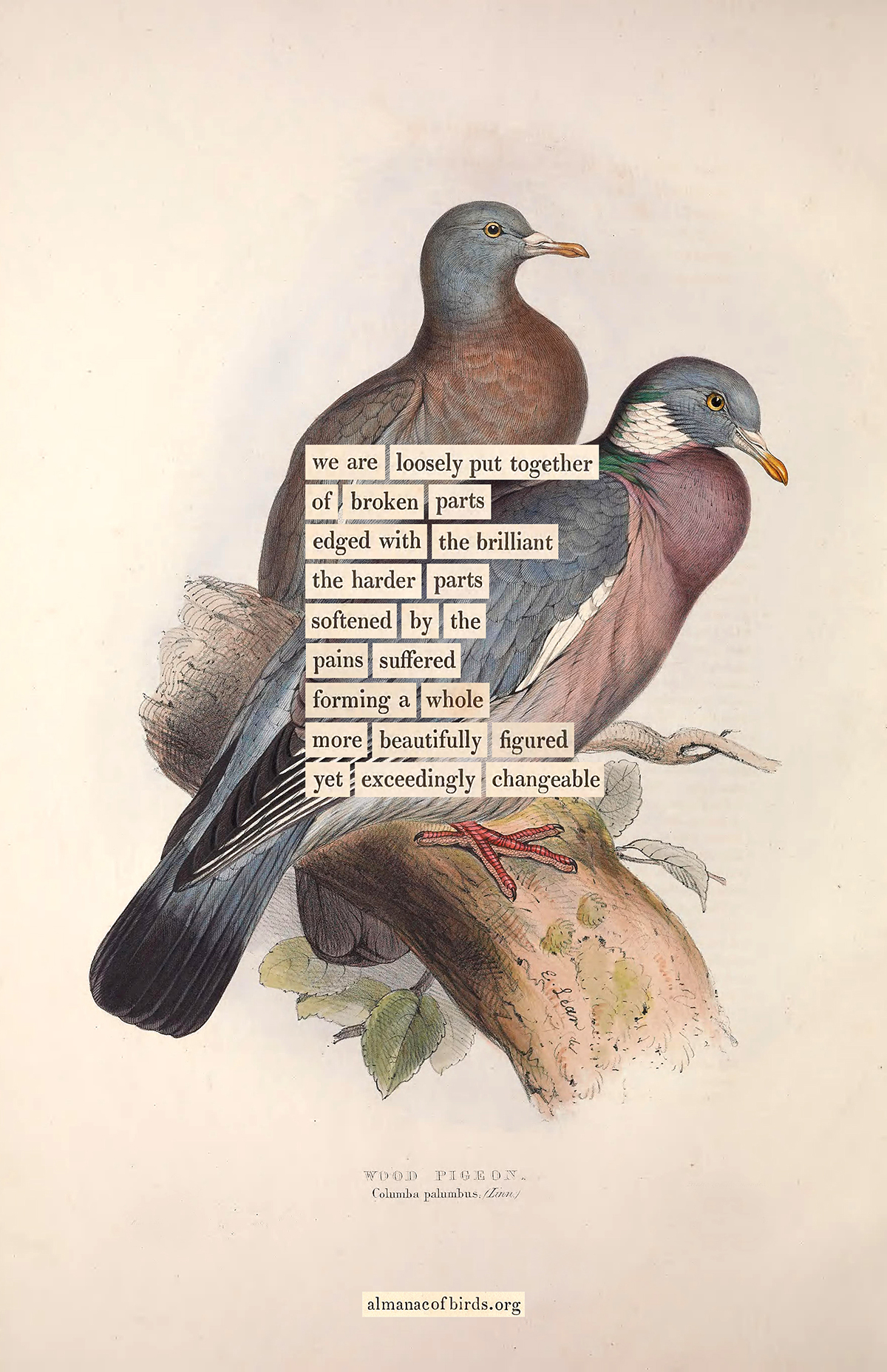
Available as a stand-alone print. Find the original deck of 100 bird divinations, along with my process and the story behind them, here.

 Hello Blog! This is the midweek edition of





Nema komentara:
Objavi komentar