3 Good Things is an interview column featuring the most passionate recommendations and sources of inspiration from creatives I admire.
I fell down the Annie Meyers-Shyer rabbit hole a few years ago, as I’m sure many of you did, when she began to share the renovation process for her beautiful LA home in real time on her Instagram account, @thisoakhouse. Her account now reaches nearly a quarter of a million followers eager to glean design inspiration and guidance. We all want a piece of Annie’s chic!
Annie’s sharp eye for creating spaces that feel special but not too fussy comes as no surprise: her mother is director Nancy Meyers, whose movie sets have become iconic for their classic, cozy charm. What I love most about following Annie is that she has passionate opinions on practically everything, from brush strokes on your kitchen island to her preferred photo-frame sizes (never 4x6!!). She’ll tell you exactly what she thinks, the result of years of cultivating a real design POV.
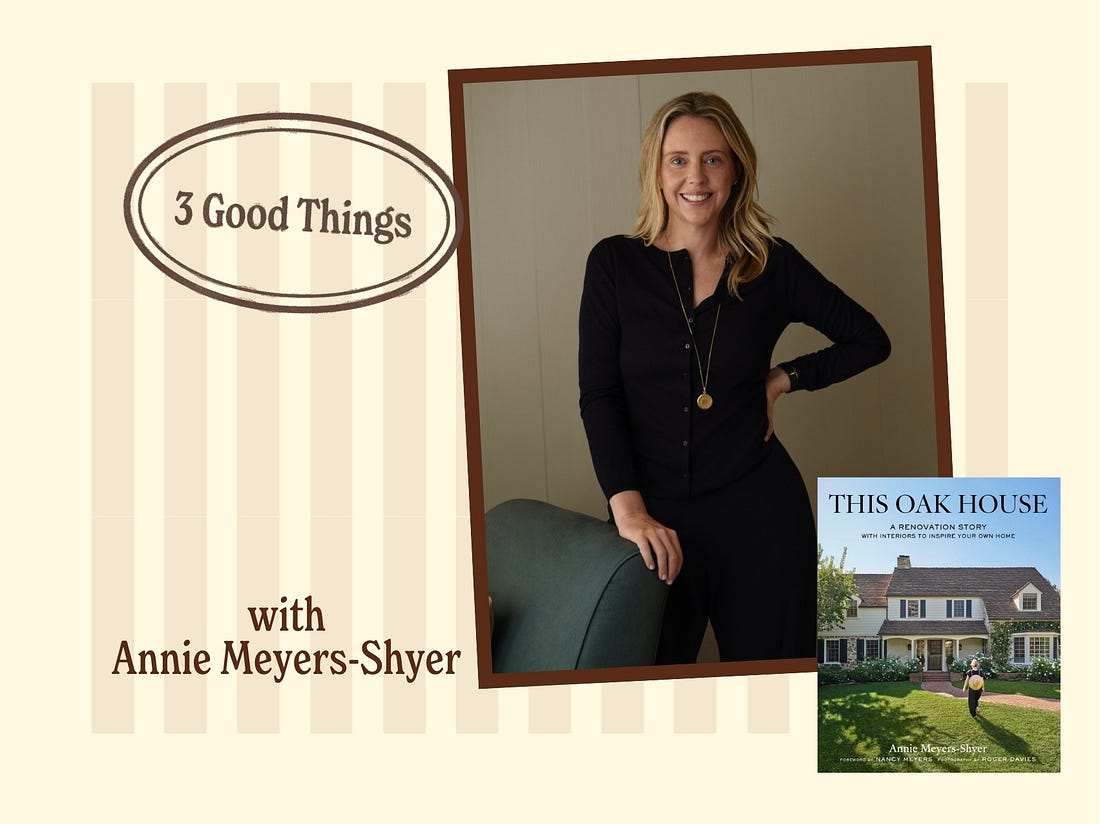
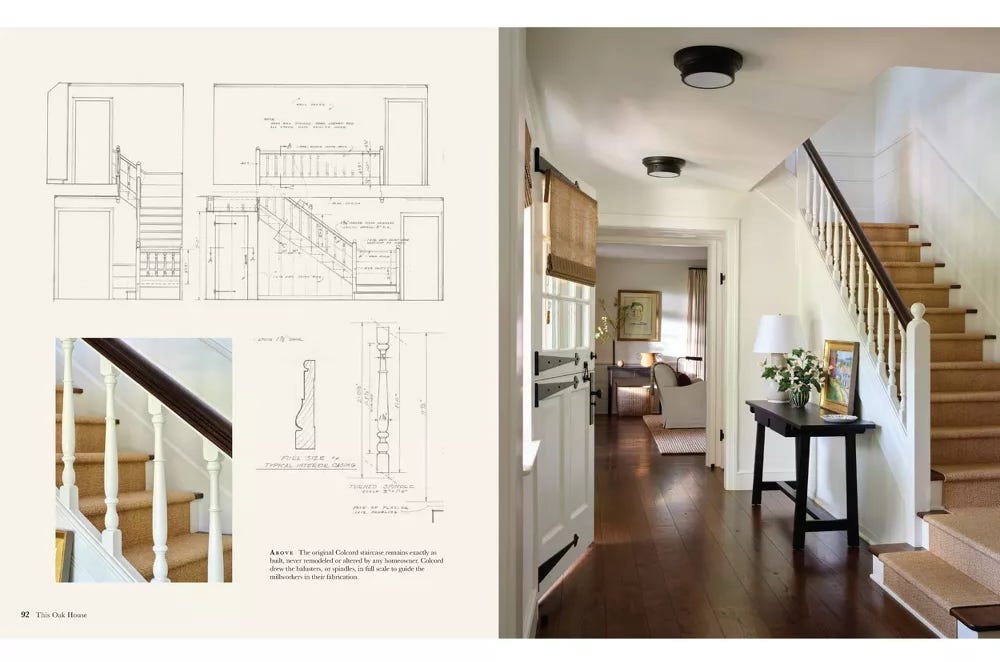
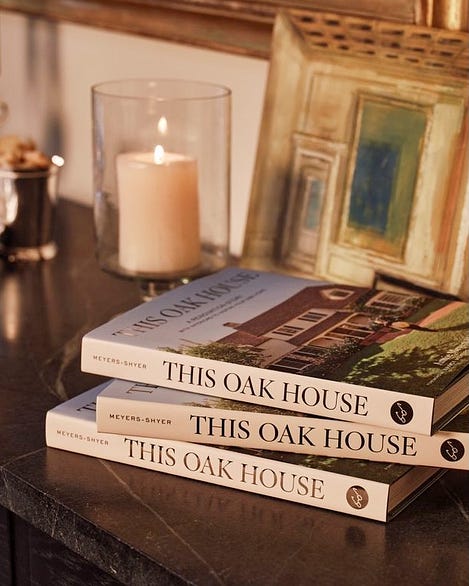
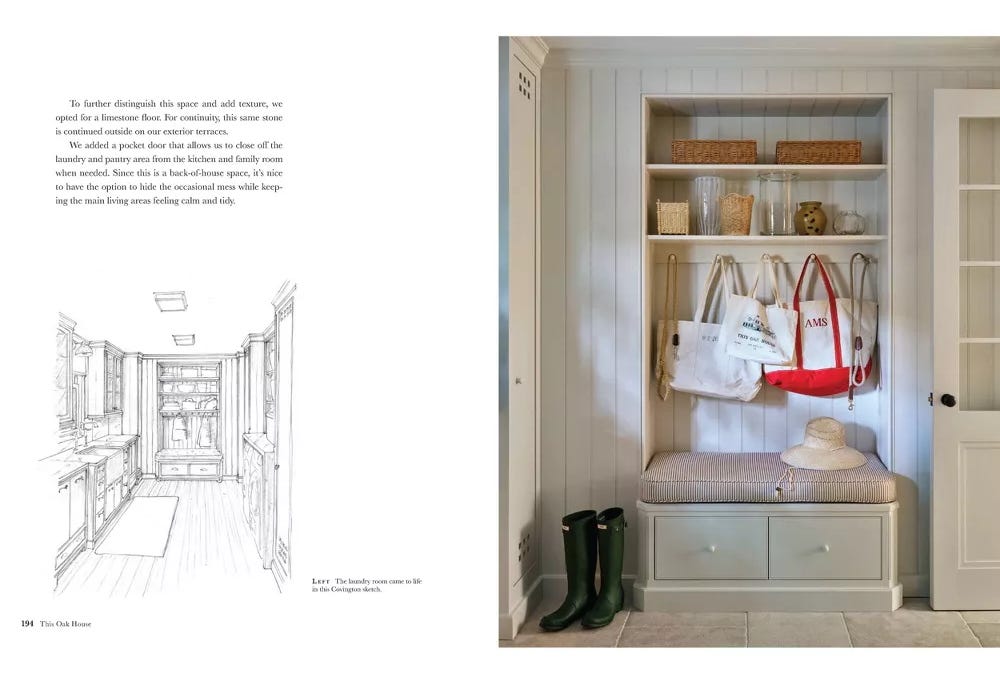
Best of all, she's generous with what she's learned, all of it now in her new book, This Oak House: A Renovation Story, published this week. (Already sold out at Bookshop, but it’s now back in stock on Amazon). I pored over my preview copy and was blown away by the level of detail included.
Our conversation felt like a catch-up with a friend, true to Annie's style. Full convo below, plus a giveaway for paid subs. Enjoy!!
Downtime is a reader-supported publication. To receive new posts and support my work, consider becoming a free or paid subscriber.
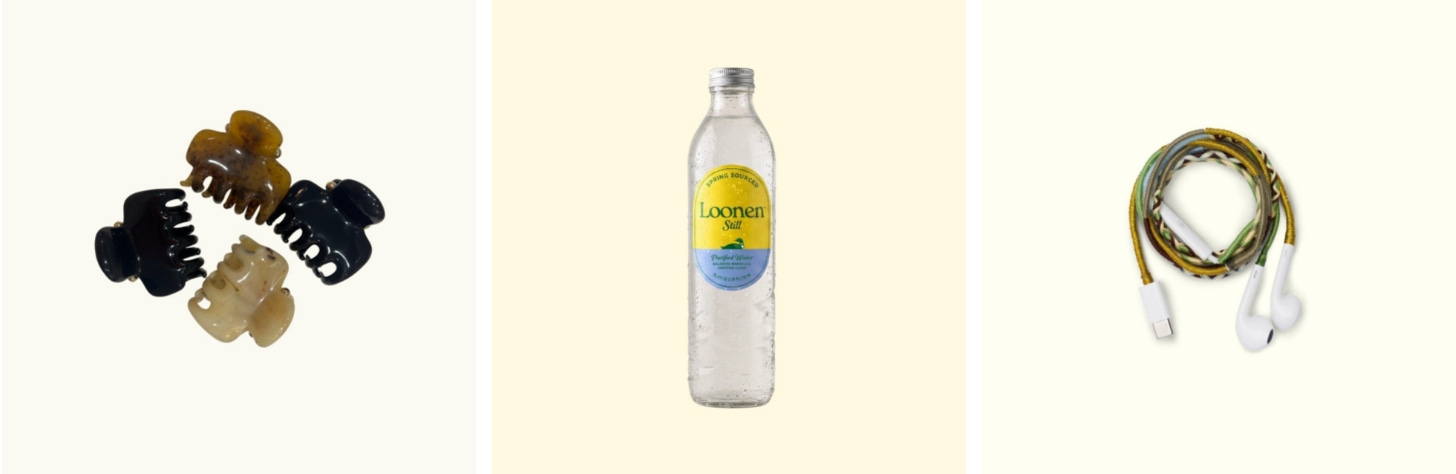
Undo Hairclips. “ The quality is just elite. They feel great in the hand. They’re just a cut above! The No. 2 style is my favorite.”
Loonen Water. “It’s a glass bottle and never touches plastic. It has a very wide mouth, which is amazing, because you can pour electrolytes or anything in it. It’s almost like the size of a Hydroflask, it’s like the perfect amount of water, and it’s just delicious. I buy mine from Good Eggs, but it’s also on Amazon.”
Wired headphones + her favorite podcast. “Only. I believe exclusively in wired headphones. I don’t have to charge them. I can have 10 pairs and they can just be everywhere. When I had AirPods, it was always like, where are my AirPods? Are they charging? And because wired headphones are like $9, you can have so many of them. And also, I listen to a ton of podcasts, so they never die.” (Annie’s favorite podcast is Heavyweight, specifically this episode about a man who remembers breaking his arm, but his family doesn’t. “It’s kind of like true crime with no crime; he’ll deep dive into a thing with somebody in each series. A very charming host.”)
Freecity Sweatpants. “Get the non-logo version. They have no pockets, which I think is a great thing. So there’s no bulk. They fit great. They’re soft. They wash well. Love the colors. They’re just kind of like the quintessential perfect sweatpant to me.” [Ed note: I found some available on Poshmark for $45+. This pair from a different brand looks like a similar alt.]
how to approach designing a home when you have little kids
the best advice for betting on yourself
what her mom taught her about parenting
her absolute favorite LA spots + a giveaway (exclusively for paid subscribers of Downtime :))
Alisha: Annie, congratulations on your book! The level of detail in it is insane. We recently redid our kitchen, and I kept thinking, I wish I’d had this as my guidebook.
Annie: Thank you. I really did try to make the book feel like an extension of the Instagram account: part useful tips and tricks, part the beautiful photography you’d expect from a coffee table book. It was important to me that it felt like me. If you follow me and know my cadence, I think you’ll read it and go, “oh, she didn’t have a ghostwriter, this is all her.”
One of the things I love in a book is when you can go back to it over and over. I told my publisher on our very first call: I want this book to be dog-eared. It’s not just for someone doing a renovation. There are recipes in there, how to style a bookshelf. There should be something in it for anyone who lives in a home.
Alisha:You worked in fashion, first as an editor, then in PR at Chanel, before This Oak House. How did that evolve?
Annie: I’m born and raised in LA, moved to New York for my first job as Hal Rubenstein’s assistant at InStyle, very Devil Wears Prada. I’ve loved magazines since I was a kid. I actually started my own in fourth grade, the first magazine “for kids by kids,” and we ended up in the LA Times and on CNN before my parents made us close up shop.
From InStyle I went to Harper’s Bazaar as the accessories editor, which taught me everything about how a magazine gets made and why a critical eye matters. Then I moved back to LA and landed at Chanel, doing West Coast PR—the only corporate person out here, for six years. I got married and had two kids during that time. As much as I loved it, the travel as a brand-new mom was just too hard, and I ultimately left. It was a hard choice but the right one.
I threw myself into being a full-time mom. Then the pandemic hit, and the idea of this renovation came about. I posted on my personal Instagram: “I’ve started a house account, maybe I’ll post, maybe I won’t.” And that was it. There was no grand plan.
Alisha: The most beautiful parts of the book, to me, are about memory. Home as a way of honoring the past. What does designing a home mean to you?
Annie: A life motto for me, even before I began this project, was truly, “there’s no place like home.” It’s how I feel. It’s the place I always want to be. As a child, I felt that immensely. I loved being at home. I loved hanging out with my parents. And I think for me, the idea that home is a place where the people who live there want to be, how to make it sort of cozy and wonderful and a place you always want to return to, is key.
Because that’s how I felt about my childhood home. My house was also at the end of the street where my school was, so it was a real gathering place for my friends. And I loved the idea that my house was sort of that house, that everyone would always go to. And so I don’t know if it’s as much of a memory as it is a feeling of wanting to create a place where everybody always wants to be and gather. One of the things people say when they come to our home is like, it’s so comfortable! That makes me happy, you know?
Interviews like this one take hours of recording, transcribing, editing, and producing, and they're just one piece of what goes into Downtime each week. If you love this kind of content, a paid subscription gets you full access to all recommendations newsletters, giveaways, and all content behind the paywall. It's the best way to keep interviews like this one coming, and your support means the world to me.
Alisha: What’s the biggest lesson from the renovation process you hope readers take away?
Annie: That people feel empowered. You know, I knew so little going in. The book is a little bit of a “what to expect when you’re expecting” for renovation. I’ll get messages like “my contractor hates using Farrow and Ball,” and I write back: So? They don’t have to live there! People are intrinsically people-pleasers, but at the end of the day, no one lives here but me and my family. If someone said we couldn’t do something, my question was always why not? Explain it to me. You don’t need to come up with the answer yourself, you just need to ask the question.
The other part of empowerment is realizing anything is possible. I started an Instagram account thinking my friends might help me pick paint colors, and now I have a book. I’m 45. You can do anything at any time. It’s never too late. I found a new passion in my 40s. I didn’t see that coming. I think I was very settled in my life of being a stay-at-home mom. Like, I was very happy with that. I felt very content. I didn’t even know I had this other bucket I could fill. You know, I actually asked my editor, “am I allowed to write a conclusion?” She she said, well yeah, of course. And to me, the conclusion isn’t just about the house—it’s about believing in yourself and betting on yourself.
The book is a little bit of a “what to expect when you’re expecting” for renovation.
Alisha: As a new mom furnishing a small space with a 6-month-old and a 3-year-old, how can I balance family life with design choices I love? Like, I want the really nice chair and coffee table but I’m kind of terrified, you know?
Annie: My boys are 9 and 12 now. There’s a balance for everything. It’s okay to have more adult spaces the kids don’t have free reign in. In the family room, I use performance fabric on the sofa. A good sofa should last 50 years. Buy a well-made one, and you can just re-cover it after ten.
I’m past the sharp-corners stage, and I think you can also teach your kids. We have a no-shoes rule, and nothing makes me happier than hearing my kid tell a friend, “you have to take your shoes off.” I’m not someone who says “don’t touch anything.” My dining chairs are just sprayed with stain repellent. Make beautiful choices, accept kids will be kids, and teach them along the way. If you respect your spaces, they’ll respect them too.
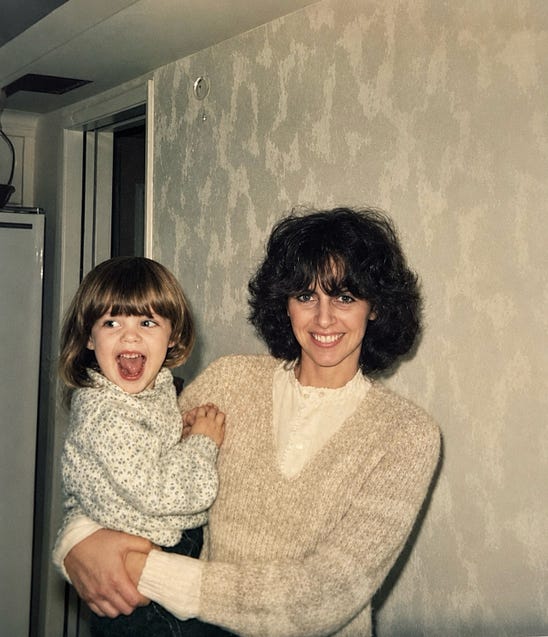
Annie and her mother, Nancy Meyers (Photo: @thisoakhouse)
Alisha: Your mother, Nancy Meyers, wrote the foreword for the book. It's clear she's had such a huge influence in how you view the world, not even just in design and aesthetics, but beyond. How has her mothering impacted the way that you mother your own kids?
Annie: You know, all people are influenced by their parents, right? I mean, that's our greatest influence, our parents. Something she did very well was, you know, she was a full time working mom, always. But I never felt her absence.
She somehow figured out how to be very dialed in while not always being home. If I had a math test, and I got home from school, the phone would be ringing at 3. “How was the test? How’d you do? What was it like?” You know, she was so tuned in to me, always.
I took a class when my kids were babies, and the woman who led the class told me a story of how she was working from home. She was always sort of like, on the phone, rushing around with her kids, and trying to balance everything. Then one day, she got an office outside the house where she would spend a lot of her time. After that, she was only really home for bath and bedtime. She was giving her kid a bath one night after she got this office outside the house and the kid said, “You're home so much more now, mom.” And she was like, “I'm actually home so much less now.” But to the kids, it felt different because she was just so much more present.
And so I think my mom did that so well. I think she was able to be very present. Both of my parents also very much valued my opinion and my sister’s opinion on things, even as children. They took it into, like, real consideration with anything, and so we try to do the same with our kids. I think that… That sense of,
Alisha: Yeah, I love that idea of treating kids not as adults, per se, but just more seriously.
Annie: Yes.I think what that did for me was gave me an enormous sense of self and confidence in myself. If these adults believe in me as a kid, then I have no reason not to believe in myself. And so I try to do that by honoring my own kids’ feelings, obviously within reason, and also, I value their opinions. So I think I would say that that was my mom’s biggest influences on me.
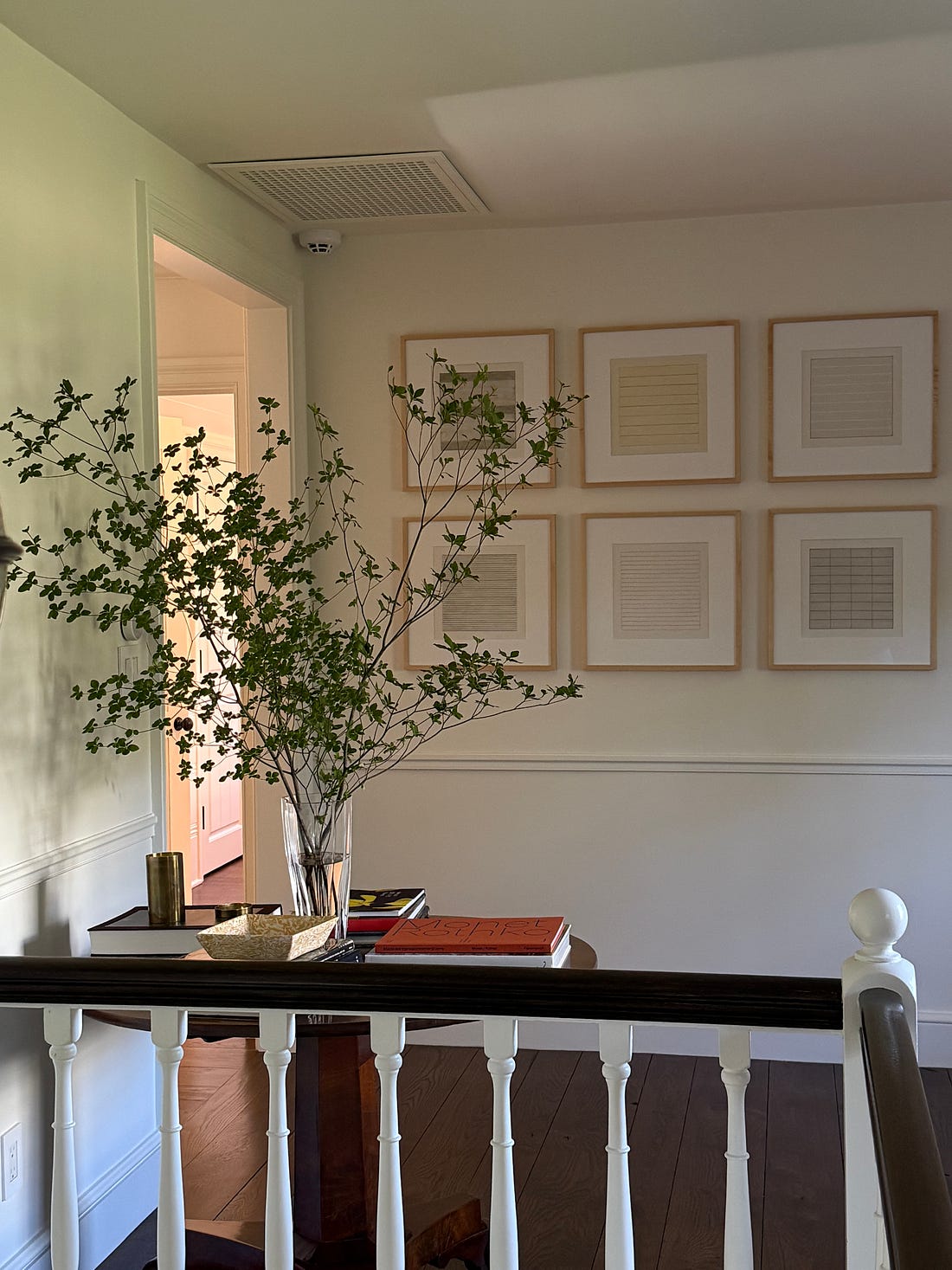
Agnes Martin prints framed in Annie’s home
Alisha: Do you have guiding principles for how you choose art, or is it purely emotional?
Annie: Completely emotional. The pieces I’ve inherited are the most meaningful. They remind me of my childhood home and my father. Beyond that, I don’t care where I find something, garage sale or gallery, as long as it’s original.
Best story: I fell for a set of Agnes Martin prints in a Connecticut shop, well over $20,000. I couldn’t stop thinking about them, so I researched and found there were actually pages from a limited-edition book she’d published. I tracked the book down at a gallery in Germany and framed the pages myself for a fraction of the price. That same book has since sold at auction for $25,000. My tip: sometimes it’s worth the hunt. If you love something, investigate it. I've done the same thing with an artist I liked in Provence — copied down his name, then found his work on French eBay.
My tip: sometimes it’s worth the hunt. If you love something, investigate it.
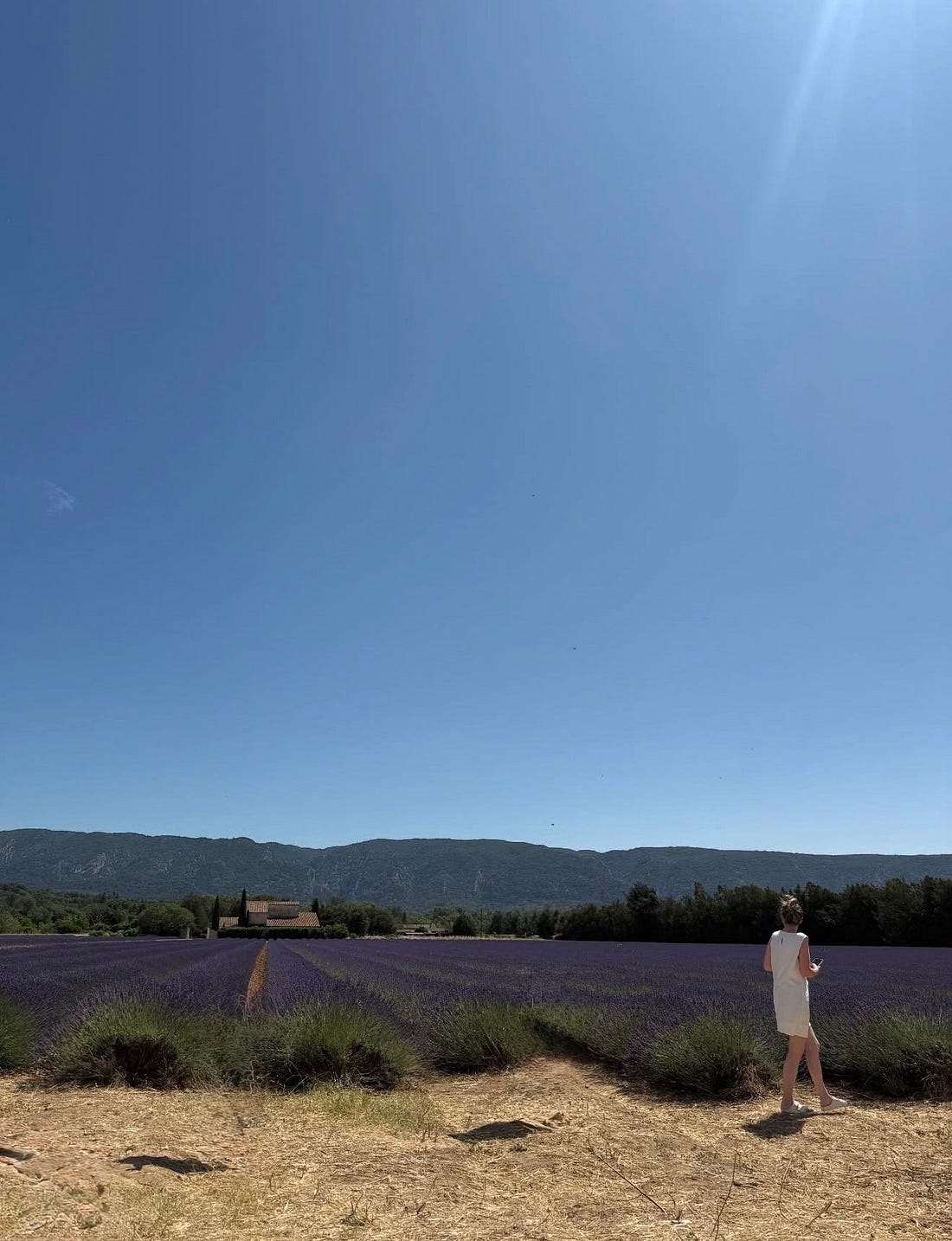
Annie in Provence
Alisha: Lastly, let’s chat about downtime. How do you like to recharge?
Annie: Downtime is core to who I am. I tell my husband I’m like an old iPhone: I get down to red fast. My version of unplugging is quiet: my bedroom, a bath, a zero inbox. But quiet doesn’t mean silent. I like knitting while watching a documentary, a podcast while I plan my week. It just means nobody’s pulling on me. I’m the person at a dinner party who says “I’ve had the best time, I’m going to put myself to bed now.” My husband’s the opposite, he comes home from a party recharged and ready to talk, and I have no words left.
Annie’s Favorite “Old School” LA Spots
“I love what I know — I'm a creature of habit, I go to the same places I've been going forever.”...
Keep reading with a 7-day free trial
Subscribe to Downtime to keep reading this post and get 7 days of free access to the full post archives.







Nema komentara:
Objavi komentar