
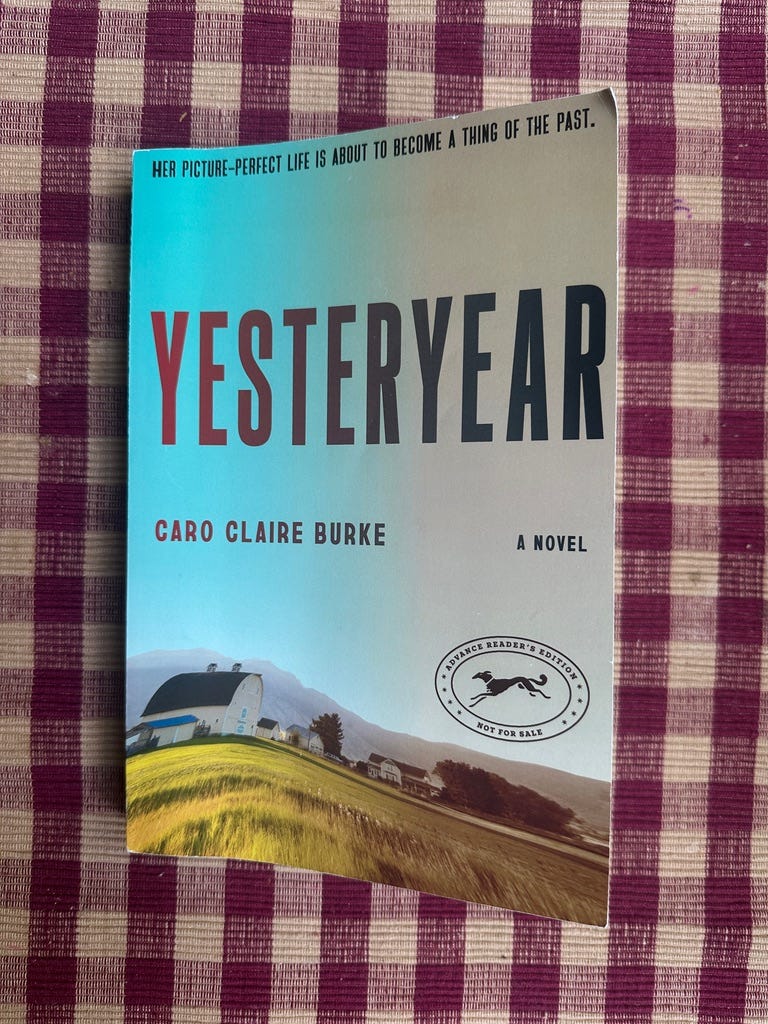
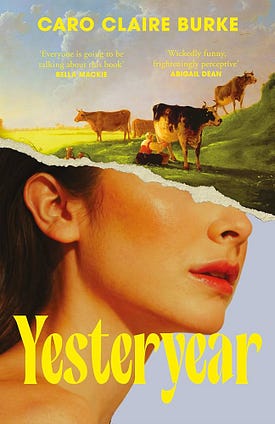
A review of "Yesteryear" by Caro Claire Burke, the tradwife novel everyone is talking aboutIs it worth the hype? Is it Ballerina Farm fanfic or hatefic?
Since I shared an Instagram Story earlier this week saying that I “did not like” Yesteryear by Caro Claire Burke, my DMs have been flooded. Responses ranged from “YES, I don’t get the hype” to “It was meh” to “Really? I loved it!!” Clearly, the tradwife novel of the year has struck a chord! Not to mention, it’s a commercial hit: Yesteryear has been on the New York Times Best Sellers list since its debut, currently sitting at #3 at the time of this writing, and has been picked up for a film adaptation starring Anne Hathaway. Ultimately, for me, this was not a five-star read, and I was overall disappointed. But! I still raced through the book, and the fact that I’m still thinking about it says something. If you’re looking for a speedy, propulsive thriller that touches on highly relevant topics, I’d recommend picking it up, if not for the subject matter, then for joining in all the fun debate and discussion happening around it. Yesteryear would make a perfect book club pick. Let’s get into what I really thought… (Without spoilers!)
Yesteryear is, in essence, a novel skewering the tradwife, told through its main protagonist, Natalie Heller Mills. Natalie describes herself as “a flawless Christian woman” who is “the manic pixie American dream girl of this nation’s deepest, darkest fantasies” — someone who is, in her own words, “perfect at being alive.” To the public, she performs a carefully curated fantasy. She lives on a sprawling farm in Idaho, which they’ve dubbed “Yesteryear Farm,” with her husband Caleb and their five children, running an Instagram account with millions of followers who either idolize her domestic, God-fearing lifestyle or scoff at her performance:
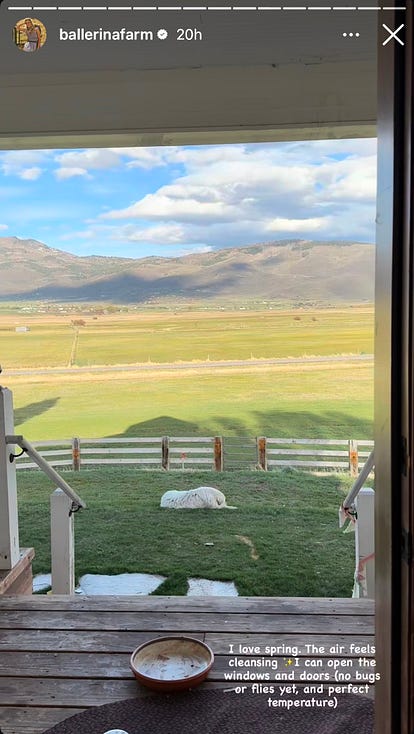
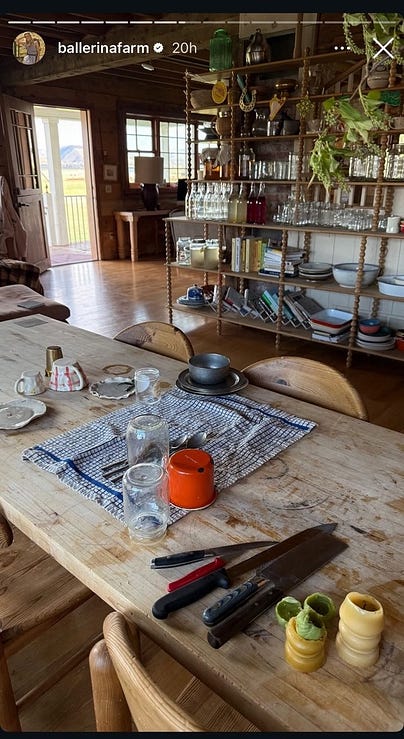
What the public doesn’t know is that Natalie and Caleb employ plenty of help behind the scenes at Yesteryear Farm — multiple nannies, farmhands, and a newly hired social media producer. Caleb, meanwhile, is the youngest son of an American dynasty, whose MAGA-coded Senator father is currently running for President. He’s a bit of an idiot though, a “man-child” who lacks real ambition. Recognizing this, Natalie takes the reins, builds Yesteryear Farm into a social media sensation, and becomes the engine of their entire operation. (If you need a real-life analog for Natalie and Yesteryear Farm, look no further than Ballerina Farm, the most well-known tradwife Instagram account from which the novel clearly drew inspiration.)
One morning, Natalie wakes up in unfamiliar surroundings — an old home, no electricity, markings on the wall that read “1855.” The novel and its mystery unfold from there. There’s a lot that I enjoyed about the book. I chuckled at many of Natalie’s angry internal dialogues because they felt so spot on (at least before they grew tiresome, because she’s very, very angry all the time). We learn that Natalie is deeply narcissistic, cynical, and disdainful of most people she meets:
Lol. The depictions of social media artifice are spot on, too. This passage in particular made me laugh because, well, it’s extremely Ballerina Farm coded:
The hordes of “Angry Women” and devoted “disciples” who follow Natalie also put into focus one of the novel’s strongest themes: that neither the liberal progressive feminists nor wannabe tradwives have it all figured out…and yet both are fervently following along Yesteryear Farm. I wish the novel dug into this theme more, that online, your biggest haters are often your biggest fans. Natalie herself puts it best:
The book also does pointed work around child influencing: Natalie offhandedly notes that her daughters were “easier to train for the camera” than her sons. Chilling!! But here is where the novel lost me: Yesteryear doesn’t fully explore the interesting themes and questions it raises. I couldn’t understand Natalie as a character. While the mystery kept me racing through its pages, the lack of character development ultimately kept me from fully investing in and enjoying the book. For instance, Natalie grew up Christian in “a small mountain town,” with a single mother, but we don’t get many specifics about that. Which denomination of Christianity? What beliefs does she specifically hold dear, and which does she struggle with? Natalie gets into Harvard. But at Harvard, she quickly becomes disillusioned by what she finds there: “modern women” who hate men and want to party and hook up rather than learn, and whose greatest ambitions include becoming consultants at McKinsey. That’s a rich origin story, but the specifics felt vague and underexplored. As someone who went to Harvard from an Evangelical Christian background, I was especially keen to compare notes on Natalie’s experience vs. mine. But overall I found Burke’s portrayal of the place unconvincing, which lost my trust in the book early on. Burke relies on the very obvious biases and assumptions people make about a place like that: that the students are all stupid, spoiled rich kids who come from hyper-liberal coastal elite families. Natalie’s choice to attend Harvard felt like a convenient shorthand to establish that Natalie is intelligent; there was no exploration as to why this specific college and no nuanced exploration of the various beliefs and teachings she’d find there. And without a believable account of how that formative environment actually shaped her, I had to make some very big leaps of faith to buy into Natalie’s decisions that shape the plot: to drop out, marry someone like Caleb, become a SAHM, and then feel “trapped” later on. There are other bits in the book (the depiction of motherhood, politics) that suffer from this same problem of underresearched overgeneralization, hand waviness, little nuance…basically straw man arguments that are props for the plot to zip forward. Which maybe was the point for a novel like this one. Lastly, what didn’t work for me was that twist. When it arrived, it felt anticlimactic, and the resolution was a bit too neat. I wasn’t sure what message the twist was trying to convey about any of the rich themes the novel could’ve explored through the lens of tradwife culture: female ambition, political ideology, motherhood, toxic masculinity, the list goes on. Tradwife culture is especially deeply tied to politics, but again, there are no specifics about what ideology Natalie or Caleb subscribe to, only vague MAGA-coded references. All of this made me wonder: what is this book trying to say or achieve about our current climate? I want to give the author the benefit of the doubt (whose other work I love and admire, especially her podcast which she co-hosts, Diabolical Lies). Maybe this was a marketing mix-up? I went in expecting something closer to literary historical fiction and got something more like a Black Mirror episode. Had my expectations been set correctly, I might have felt differently about the book.
I’m glad I pushed through and finished the book, because I was able to reaffirm something about my reading preferences: that I’m a character-driven reader who needs fully fleshed-out characters; a high-concept plot alone can’t substitute when they’re absent. All that said, Yesteryear kept me reading. It sent me down a deep Ballerina Farm rabbit hole at 9pm on a Tuesday (I understand the fascination now!!), and I’m genuinely looking forward to the film adaptation. If you read this book, what did you think? Let’s discuss in the comments! No spoilers please. Read “Yesteryear” if you like: Mystery-thrillers, plot-driven books, dark humor, Black Mirror. Yesteryear, by Caro Claire Burke (Knopf, 400 pp., $28). Purchase it on Bookshop, Amazon, or Libro.fm.You’re currently a free subscriber to Downtime. If you love what you read and discover here, consider upgrading to paid for the full experience and get access to exclusive subscriber-only content. THANK YOU!
|





Nema komentara:
Objavi komentar