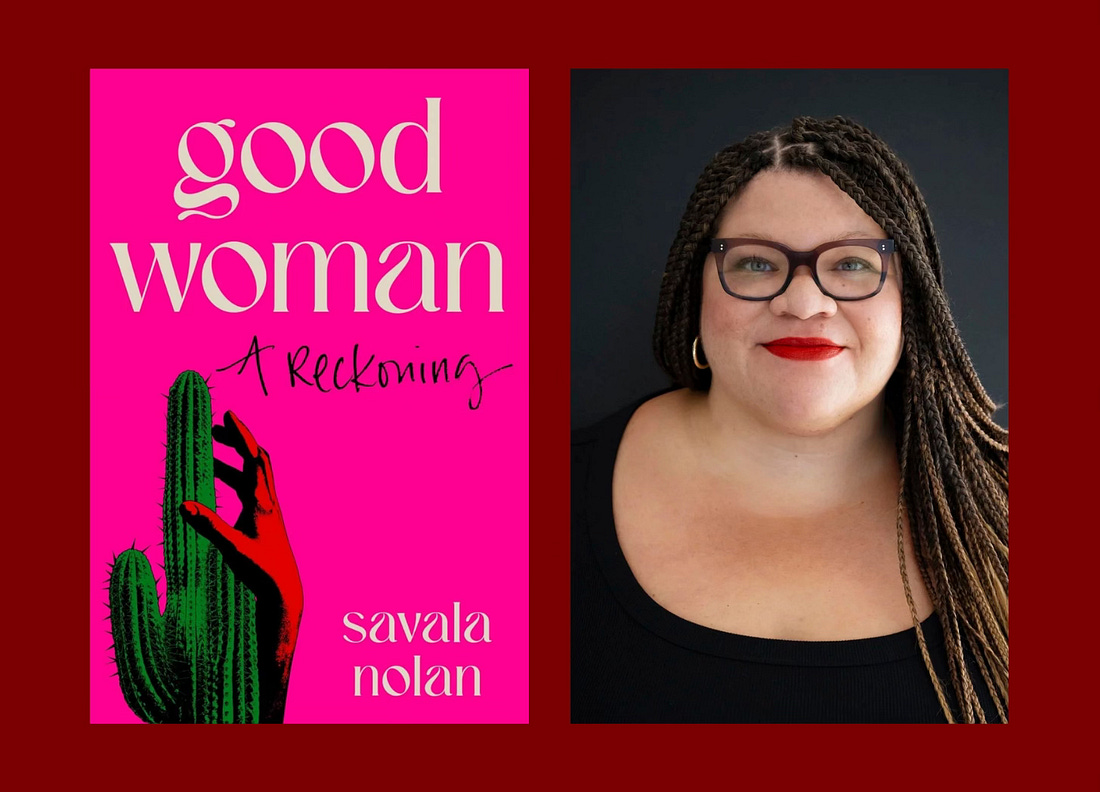
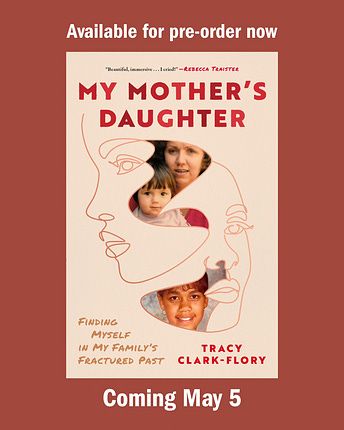
My book, MY MOTHER’S DAUGHTER, comes out in eight weeks. TWO MONTHS. Pre-orders mean everything for a book’s success. It tells booksellers that people want to read it and shows my publisher that this book is going somewhere. Will you take a second right now to pre-order my book? You’ll be an essential part of launching it into the world. 'I’ve been so good for 40-something years and I’m a husk'Savala Nolan, author of 'Good Woman,' talks about divorce, midlife reckonings, diet culture, god as a mother, dating for pleasure, paying for sex, and more.
For most of her life, Savala Nolan tried to be “good.” This meant everything from starting her first diet at 5-years-old to attempting to single-handedly save her marriage. “I have tried to not rock the boat,” she writes. “I have tried to accept what we are asked to sacrifice and become.” Then in her 40s, and in the midst of a divorce, Savala started reckoning with the bill of goods that she had been sold. All that endurance and performance left her hollowed out—and Savala realized she was done with trying to be good. Her resulting essay collection, Good Woman, is “at once poetic, fierce, tender, sexy, and scholarly,” as I wrote in my blurb. She takes abstract concepts, like patriarchy, and turns them into bodily sensation and experience. Savala is so beautifully and refreshingly alive—as a writer, thinker, and person. I feel a little bit changed every time I read or talk with her. Luckily, I got to do a bit of both this week, because I was in conversation with her for her book launch at Book Passage in San Francisco’s Ferry Building. On Tuesday, we sat in front of a standing-room-only audience and talked about midlife reckonings, diet culture, god as a mother, dating for pleasure, and paying for sex. Afterward, we grabbed some oysters and champagne next door at Hog Island, and watched the white lights of the Bay Bridge dance across inky black waves. It was so good and I’m happy to share a small slice of the night with you here. Our conversation has been edited for length and clarity. Your book opens with one of the most visceral descriptions of both patriarchy and the coercions of “good womanhood” that I’ve ever read. You describe being chased “one’s whole life” by “that towering, unstoppable, spiny, screeching shadow,” and the feeling of its “barbed, breathing, sentient presence gaining on you.” And it feels like by saying in these opening pages, “I refuse to be good,” you’re turning around and looking that spiny, screeching shadow in the eye. What does it feel like to stop running? It feels great. I highly recommend it. I don’t think it felt great at the very beginning of what I would call a reckoning with my social conditioning. At that point, it just felt scary and infuriating. The bargain that girls are sold is if they are good enough in a particular set of ways—quiet, agreeable, pleasant, pretty, male-oriented, available, helpful, in control of the size and shape of their body—they’ll be happy. That’s the path to fulfillment. Very often, the threshold is being chosen by a man, if you’re straight, although gay women and women of all sexualities probably get that message, at least when they’re children. Like a lot of people, something about midlife caused me to look around and say, Wait, I’ve been so fucking good for 40 something years and I’m a husk. I’ve poured so much of myself out in order to be safe from patriarchy, to comply with it in every aspect of my life, from who I am at work to how I have sex to how I relate to God. I hit a point where I had to contend with the emptiness of the promise. I had to contend with the bill of goods. And when I first hit that inflection point, the first emotion that I felt very clearly was fear, because there’s a reason that women conform. And it’s because when women conform, we’re relatively—relatively—safe. We’re still in danger. It’s still precarious. But it’s not as dangerous as if we say, Fuck this. That’s the feeling I had. It’s like, if I do what I have to do to obtain myself, I lose everything else. And that’s scary. But being several years into this process of reckoning, I would never go back. I love getting to experience womanhood in ways that are not so mediated by gender hierarchy. It’s something a little more, I don’t want to say feral, because it’s not about being, like, wild. It’s not an aesthetic, right? But it’s… earthy. There’s something germinal about womanhood experienced with less of the glaze of gender hierarchy. You write about the end of your marriage, and all the work that you put in—as so many women do—around trying to save it. How vital was leaving your marriage to this new era of refusal for you? Was it your first radical act of rejecting notions of goodness? My ex-husband and I have a daughter who is our shared pride and joy. He’s a wonderful dad. He has many gifts. I was madly in love with him for all kinds of good reasons. And it didn’t work out. So it’s easy when you’re talking about divorce to make it seem like somebody was terrible, but it’s not that simple. But what the marriage required of me was so extreme. It was such an intense level of emotional caretaking, of being the foreman who was managing the entire production line, and in a setting that was… not feminist. So, leaving my marriage was absolutely one of the first major reckonings. It was an instance of understanding that I, like so many women, had married in part because I was assured by the culture that’s how I become a worthwhile human being, you know? You think about The Little Mermaid. Ariel literally gives up her voice—her ability to express, consent, refuse—in order to get her happy ending, which is a man falling in love with her. She also gives up her body. She gives up her family, she gives up her home. I was a bit of an Ariel and I would have had to stay one to stay in my marriage, because those were the terms of the marriage. They were unspoken terms, but they were the lived terms. I would say, however, that the very first thing I did to start reckoning with my social conditioning was to realize I could no longer diet and eat in ways that were meant to shrink my body or maintain a small size and exercise compulsively to that end, which I had done from age five to 35. For the many wonderful gifts that my mom gave me, one of the things that she passed down, which was passed down to her, was an anti-fat sensibility. I was a chubby kid and I learned very early on that there was a certain amount of safety that I could only attain by fixing the “problem” of my body. But at a certain point, it was like muscle fatigue, I just reached a point where I had to stop. Many women have no idea what life is like if you’re not trying to control the size and shape of your body. That’s off the map for most women. So, again, an element of terror, but I would never go back. You couldn’t pay me to take a GLP-1 now, but there was a day when I would have been selling my plasma to get vials. I’m not even kidding. You write that not having “the right kind of body, the good kind,” is a gift. What is the nature of that gift—what can be gained and learned from it? There’s like 5,000 things I want to say in response to that question. The first thing I want to say is that what is beautiful is cultural. Not all cultures prize thinness. That’s just an important thing to recognize at the outset. The thing about not having a quote “good body” is that you live in the margins. You’re inherently pushed out of the kind of sweet, hearty, heartwood of the center of the culture where the goodies are, but where the goodies require extreme compliance. And it’s not to have rose-colored glasses because the margins can be hard. They can be a place where, politically, you’re facing annihilation or where resources can be scant. But, also, if you picture a book, there’s the typeset and then there’s the margin. Where can you add your own thoughts on that page, right? Being on the outside of a sick culture is actually kind of salutary, it can break apart the yearning to get to the middle, which is a treadmill from the cradle to the grave for almost everyone. Almost everyone has something about them that the center doesn’t want, that they have to conceal, repress, change, be ashamed of, whatever. I’d rather write my own notes on the side of the page. Does that answer your question? Yes. I remember you use this phrase in the book, “the vitality of the margins.” Oh that’s good. It was good, you wrote it. Yeah, there’s space in the margins. There’s space and, by the way, there’s great people in the margins, too. Something about being marginalized almost creates a drive to form community and mutual care in a way that the center isn’t all about. So, again, there’s ways that being marginalized absolutely sucks. In this political climate, it would be obscene and negligent not to point that out, but there are other ways that, like I said, in a sick society, maybe it’s better to be at the outside. In your essay titled “Witness,” you write about “what it means to descend from slaves and slaveholders. To haul that irreconcilable contradiction around in my body.” Speaking of the body, it seems there is such a profound physicality to your processing in this essay—from wiping your tears on the walls of Sally Hemings’ dwelling to your digging with your hands in the dirt on your ancestors’ land in Virginia. Tell us about that—what did it mean to physically show up in these places in that way? Thank you for bringing up witness. It’s my favorite essay in the whole book. Believe it or not, this actually goes back to stopping dieting. Before I get into that, I’ll very quickly set up “Witness.” I’m descended from slaveholders and enslaved people. And long story short, through much research and archival, this and that, I found the land in Virginia—rural Virginia, like Confederate flags everywhere Virginia—that the white people in my family owned and on which they trafficked and enslaved children and men and women for decades and decades. I made a pilgrimage to that land and, since I was in Virginia, I also went to Monticello. Has anyone here ever renovated where they live, the house they live in? Even just replacing the drywall or something—not fun, right? It’s very unpleasant to be in a space that is under renovation. It’s very uncomfortable, like, Get me out of here, when is this gonna be over? Most women live in bodies that are constantly under renovation. We’re very acclimated to the inherent discomfort of that. Most of us are six weeks old when we have our first brush with diet culture, because our moms are trying to bounce back. It’s pre-verbal, but it’s in the energetic field, right? We’re very acclimated to being in a home that is constantly under renovation and will never be good enough. One of the benefits of me deciding that my body type is fertility goddess, and that I’m not going to renovate, is that I could sit in my home. I just got a chill, sorry. It’s very powerful for me. When you can sit in your home as a woman, as a man, as whoever you are, doors open, soil tills itself, seeds that have been disrupted by the renovation can pop up, and I think you can face things. If I had still been dieting, I don’t think I would have had the embodied patience or space to go to that land and sit on the soil, where enslaved children were picking tobacco. Or to bear witness to Sally Hemings, her joy as a mother, her suffering as an enslaved person, the whole completeness of her. Try to do that when you’re living from the neck up. It’s gonna be a pretty thinned out experience, right? You have to be from the neck down. I had to be willing to sit in my body. So, most of my writing comes from my body in some way, and I think that’s just a very clear example of it in that essay. One of your essays is devoted to the idea of reframing god as a mother, as opposed to the traditional patriarch, because your understanding of god is much more aligned with what you have seen of mothers than fathers. How did this reframing change your relationship to god? It really deepened and enriched it in ways that I’ve yearned for my entire life, but have never quite been able to wrap my arms around. I don’t care what people believe, I’m not proselytizing, I’m not evangelizing for any particular god, you know. I just care how people show up in the world. But my experience was, like all of us, the only way we’re allowed to imagine God in this culture is as a father. That’s how we talk about God from a basic Judeo-Christian standpoint as a culture, right? And um it’s in the art, it’s in the grammar. I mean, it’s just, it’s everywhere. It’s in the pronouns. I felt in trying to connect with God the Father for most of my life that it was like you and I sharing a plate of spaghetti and you saying, “Oh, this chocolate sauce is so good.” There was some disconnect between what I was hearing about and what I was experiencing. And I couldn’t figure out what the disconnect was for my entire life until I became a mom. I gestated a child and bore her into the world. And I began to experience and to witness what motherhood is like, compared to fatherhood, painting with a broad brush. I began to understand these qualities that I was taught to see and trust in God the Father, like round the clock caretaking, unconditional, infallible devotion, protection beyond what you can comprehend, right? Those are motherly qualities. Once I got that, the door just flew open. I was like, Okay, I can talk to God, same way can call my mom. know? Like, sitting up around the clock all night, three in the morning, holding a washcloth to your head when you’re sick? That’s mom. Now, it’s really important for me to express that anyone can mother. Motherhood, I think, is a verb. And it’s not about your biology or even whether you have children. People mother their aging parents. People mother their husbands. People mother their coworkers. So it’s expanded my vision of what God is and my connection to God, but it’s also expanded my vision of what is possible if we were to orient ourselves towards caretaking and were to start to see motherhood as actually the only metaphor for a God that is worth worshiping. Motherhood is the set of human behaviors, whether it’s a mom nursing a newborn or a man giving a bath to his aged father, right? That’s the only set of human behavior that is the proper metaphor for the kind of caretaking and love that we’re talking about. You spent your younger years dating with this always-looming question of: Is he the one? Then, in your 40s, post-divorce, you were suddenly confronted with the question of what it would mean to date for pleasure, as opposed to marriage. How has this reimagining changed your ideas around sex, dating, and love? Isn’t it wild that every date I ever went on, even with people I was repulsed by, at the back of my head was the thought, Is he the one? Is this the beginning of the journey? Women, you know what I’m talking about. So, I divorced. At a certain point, I was ready to have sex again. Sex is a human need for many of us. I am one of those many. But I did not want to date. Not even date. I didn’t want to spend 10 minutes at a bar flattering somebody. And I’ll tell you why. I had nothing to give. I was so emptied out from parenting, good woman-ing, trying to save my marriage. Fumes. I had absolutely nothing to give to a man. Just couldn’t do it. Well, how do you get laid if you have nothing to give emotionally? You could pay for it. You can trade money. And you know what? We all do it in ancillary ways. The bikini wax, the push-up bra, whatever. But you can pay for it directly, too. I have to contend with the fact that as a woman, what I am allowed to trade for sex is my emotional labor and my caretaking. My money that I earned at my job that is in my bank account, that would be frowned upon. It’s too hungry. It’s too much appetite when you’re a woman. So what did I do? No. You’ll have to read the book to find out. Have you pre-ordered MY MOTHER’S DAUGHTER yet? My book comes out May 5 and every single pre-order works to set this book up for success. Rebecca Traister calls it “beautiful, immersive.” Irin Carmon says it’s “a powerful, searching, and honest reckoning with the complicated inheritance mothers pass to daughters.” And Savala Nolan says, “I will tell every mother and daughter I know to read this luminous, resonant bell of a book.”
|
četvrtak, 12. ožujka 2026.
'I’ve been so good for 40-something years and I’m a husk'




Pretplati se na:
Objavi komentare (Atom)
☀️ Is Society Real?
Like these? ͏ ͏ ͏ ͏ ͏ ͏ ͏ ͏ ͏ ͏ ͏ ͏ ͏ ͏ ͏ ͏ ͏ ͏ ͏ ͏ ͏ ͏ ͏ ͏ ͏ ͏ ͏ ͏ ͏ ͏ ͏ ͏ ͏ ͏ ͏ ͏ ͏ ͏ ͏ ͏ ͏ ͏ ͏...

-
Plus: Kicking off Pride Month with the new Goodnewspaper and more good news to celebrate! ...
-
Plus: A landmark ruling for new fossil fuel projects and more good news to celebrate! ...
-
Plus, a roundup of links and fun finds from the week. ͏ ͏ ͏ ͏ ͏ ͏ ͏ ͏ ͏ ͏ ͏ ͏ ͏ ...


Nema komentara:
Objavi komentar