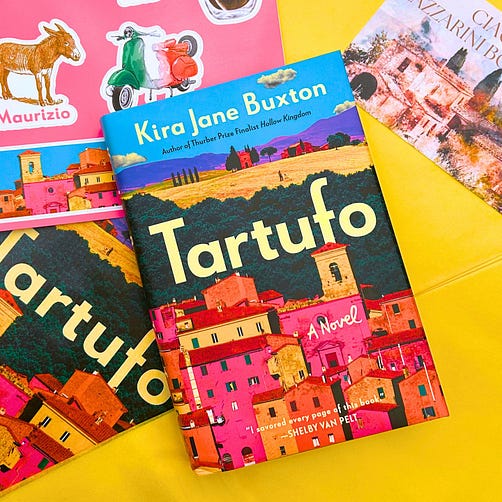
Hi! I am so, soooooooo close to hitting a big paid subscriber goal. If you’re reading this and would like to upgrade, you’ll unlock all Friday recommendations newsletters, our reader chats, and all 160+ posts in the Downtime archive. Consider joining us by hitting the button below. THANK YOU. Book Chat: 'Tartufo' is the book we all need right nowSet in a Tuscan village filled with quirky characters, giant truffles, and one endearingly clever dog, 'Tartufo' is a funny, heartwarming book about the power of nature and community.
It seems we might all be searching for some positive escapist reads these days, and who can blame us? There’s one type of book I’m drawn to again and again when this feeling hits: a book set in Italy. A book set in Italy is my literary comfort food. Still Life by Sarah Winman carried me through a bleak month. The Sicilian Inheritance by Jo Piazza pulled me out of a reading slump last summer. The Marriage Portrait by Maggie O’Farrell gave me the dark, atmospheric, historical novel escape I craved last winter. What is it about Italy? It’s a place that captures the imagination. Its people are vivacious, full of fight. Its history is rich, ancient. And obviously, the food! The food casts a delicious spell on the page and off it. All this and more are perfectly captured in Tartufo by Kira Jane Buxton.
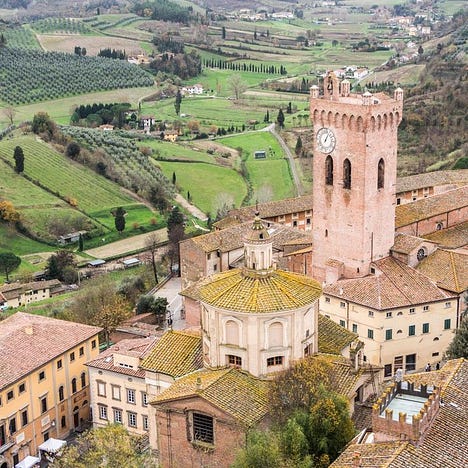
I picked up Tartufo on a whim, one of those rare books on NetGalley that called to me not because of its cover, a well-known author, or hype on Bookstagram or Booktok, but because of its premise: A rare, monstrously large white truffle (the largest ever found!) is unearthed in the fictional, dying Italian village of Lazzarini Boscorino, upending the lives of its inhabitants in a frenzy of greed, ambition, and existential crisis. Because, as it turns out, a truffle is never just a truffle. *** A Quirky Cast of Characters, Both Human and NotThere’s so much to love about Tartufo, but what makes it truly transportive is its fairytale-like quality—a story that feels like stepping into another world. From the very first page, the reader is met with a promise of enchantment:
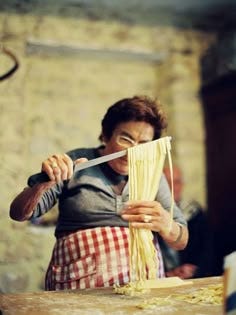
There is no single protagonist in Tartufo, but rather an ensemble cast of quirky characters that intersect, clash, and ultimately, orbit around the mysterious truffle. Among them are:
There’s more humor and delight in the way the author perfectly paints even minor characters. The village’s disgraced postman is “a wet weekend of a man.” The village priest is “a plump man of God, blessed with biblical black eyebrows like two Pekingese guarding the temples of his bald head.” Buxton has a talent for not only funny descriptions but absurd dialogue and situations as well. One villager arrives in an elaborate papier-mâché costume, only for another to exclaim, horrified, “He has come dressed as a testicle!” (He was dressed as a truffle.) Giuseppina, offended by a slight against her espresso, declares:
To which another character dryly replies, “Yes, it’s essentially formaldehyde, you are preserving them all.” LOL. But Tartufo’s real magic lies in its treatment of the non-human. The animals, the land itself, even the truffle—everything hums with personality, intent, and a touch of mischief, ready to mess with the humans they share the land with:
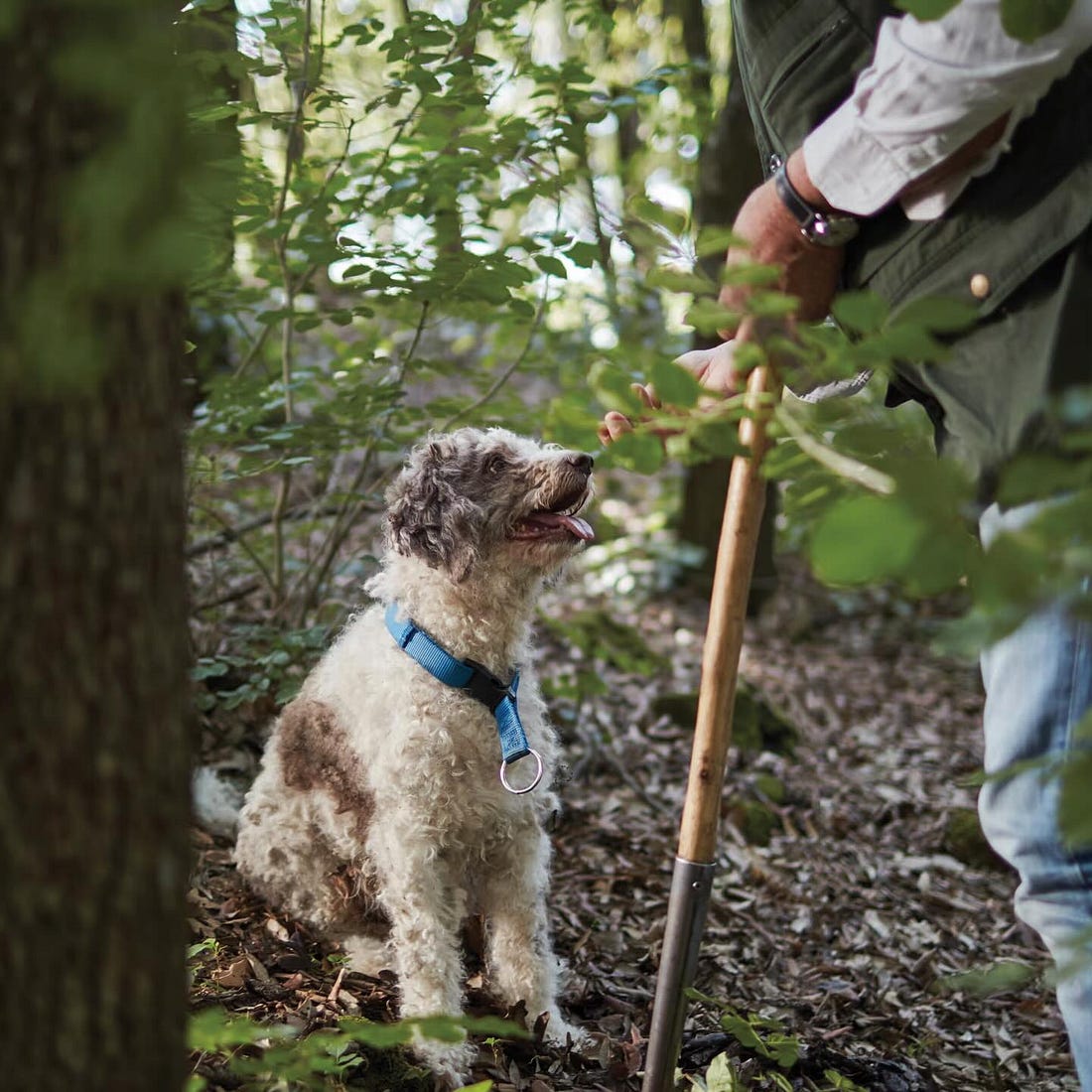
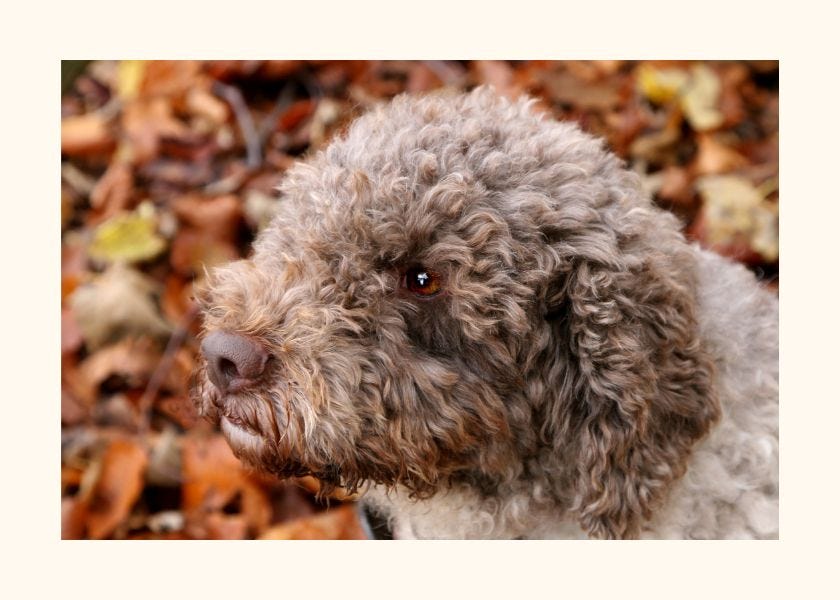
Aria, Giovanni’s dog, is no mere pet—she’s a “dog-shaped burst of brown and white corkscrew curls” with “alert, almost-human hazel eyes.” She reads emotions in scent, from breakfast pastries to human sorrow (she sniffs out “sadness the color of crushed irises” in the village vet). Buxton often takes a birds’-(or bees’?)-eye-view of a scene, painting sweeping, cinematic views of what’s happening down below in the human world. For instance, a honeybee embarks on a quest for nectar in a passage that reads like a miniature epic:
The menacing village patrol, a female cat named Al Pacino, is “best described as a cross between a crumpled tuxedo and a well-used toilet wand.” Even the truffle itself is described in godlike terms, an ancient force lurking beneath the surface, waiting for its moment, “muscular and monstrously overgrown.” A Story of Nature, Community, and ConnectionOn a deeper level, Tartufo is a book about about the folly of human ambition, the power of nature, and the lasting love of community. The truffle is used as a metaphor throughout to describe the way humans try to cultivate and capitalize on what was never meant to be ours:
The book argues that the little things are the big things. There’s beauty in observation, in being in awe of and in harmony with nature. A truffle is not a valuable fungus to be controlled, sold, or consumed, but a tiny god to be worshipped, respected. Tartufo is about what it means to belong to a place, even as it changes beneath you, and even as you try to run away from it. At one point, mayor Delizia reflects on her desire to abandon the tiny village and all its intimacies for a life of anonymity in a big city. After all, in “a tiny tight-knit village—try as you might—you can never hide from who you are.”
To escape a village like this is the dream, Delizia thinks. A village where everyone knows your past, where your childhood mistakes are still fresh gossip at the bar. Where there are more cats than people, and they, too, seem to be judging you. But by the time the novel reaches its quiet, revelatory ending, the truffle has done what it set out to do: it has forced the village to reckon with itself. And as one visitor reflects, perhaps it was never about the truffle at all:
Casting aside the glitz and glamour of the spectacle of the giant truffle, the town is pared down to its very earthly bones, the core of what matters: caring for one another. As one resident says, in what feels like a thesis of the novel:
A little sentimental? Maybe. But sometimes, that’s exactly what we need. If you’re in the mood for a book that will make you laugh out loud, make you dream of sun-drenched Italian hillsides, and make you reconsider the profound existential power of fungus—Tartufo is worth your time. It’s a little bit ridiculous. A little bit profound. And, like all the best things in life, utterly delicious.
Tartufo might be for you if you enjoyed:
Or…if you’re planning a trip to Italy soon, perhaps? What beautiful things have you read lately that’s lifted your spirits?
If you’ve been enjoying Downtime, consider becoming a paid subscriber to receive extra recommendations, subscriber-only newsletters, and gain access to the 160+ posts in the archive filled with advice, recs, essays, and more. THANK YOU! This post may contain affiliate links, which means that if you click something and buy it, I may earn a small cut of the purchase at no cost to you.
|
četvrtak, 13. ožujka 2025.
Book Chat: 'Tartufo' is the book we all need right now








Pretplati se na:
Objavi komentare (Atom)
How to Find Yourself Again After a Breakup
Plus: 9 Health Benefits of Eating Oats and Oatmeal ͏ ͏ ͏ ͏ ͏ ͏ ͏ ͏ ͏ ...

-
Plus: Kicking off Pride Month with the new Goodnewspaper and more good news to celebrate! ...
-
Plus: A landmark ruling for new fossil fuel projects and more good news to celebrate! ...
-
Plus, a roundup of links and fun finds from the week. ͏ ͏ ͏ ͏ ͏ ͏ ͏ ͏ ͏ ͏ ͏ ͏ ͏ ...


Nema komentara:
Objavi komentar