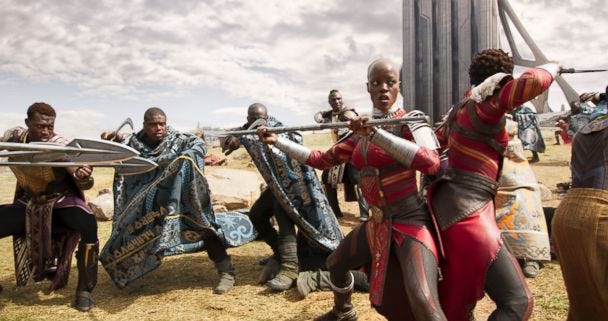
I used to be soldier number 003 on the frontlines of the diaspora wars way back in the day. I went to college amid what I would call a cultural shift of what it meant to be black, african-american, or African in America. I had arguments ready for every side of whatever debate would arise amongst friends, colleagues, and classmates. I basically critically thought my way through an identity crisis in college. For context, I’m Nigerian. I was born and raised in America. I went to college and graduate school in America. I’m now completing my doctorate from Harvard. Since college, I’ve been blessed enough to live in different diasporic communities around the world from South Africa to the UK. From my experience (I’m interested in hearing other people’s experiences), the diaspora wars tend to be concentrated in America/across the Atlantic Ocean. So here are some surface-level thoughts on the cultural shifts in America that have served as a backdrop for the diaspora wars. The “Coming to America” EraIn the 70s/80s, there was an influx of African immigrants to America during what I call the Eddie Murphy “Coming to America” era. The basic cultural engine at this time was the idea that Africa was a country [yes, you read that right. Africa was one idea in the minds of many Americans]. Homogeneity was king. The Poverty-Stricken EraIn the 90s, Africans in the diaspora began to be viewed through the lens of the civil wars and extreme poverty that were plaguing nations across the continent. The end of South African Apartheid, the Rwandan Genocide, Darfur, the AIDS epidemic, etc. all shaped the average American’s outlook on “Africa.” Humanitarian commercials convinced people that for just 25 dollars a month, you could stop these flies from swirling around this extremely poor child who most likely did not consent to being recorded. Africa to the World EraNow, the cultural shift is tending towards in the words of Burna Boy “Africa to the World”. I think this “Africa to the world” cultural era that we’re in is marked by the mass export and consumption of music genres like Afrobeats, highlife, and amapiano. The African diaspora is now seen, for better or worse, through the lens of films (like Black Panther), books (like Chimamanda Adichie’s Americanah), and other cultural products that have been spurred on by the prevalence and accessibility of social and mass media. Defining “Diaspora Wars”Amidst all of these cultural shifts, in America at least, there has been a set of discourses on who owns or has the rights to a particular set of cultural narratives and practices. This is the diaspora war. I did some digging to see if anyone has been able to truly define the diaspora wars. Here’s what I found. The Executive Editor of the student-run magazine Little Hawk describes it like this:
I think these sources do a good job of talking about the consequences and drawbacks of people on both sides of the Atlantic arguing, often online, about current and historical grievances. However, I want to take this a step further to help you see some examples of what can spark or initiate a diaspora war. I don’t want to re-hash previous real-world examples, so let’s turn to fiction. More than a decade ago (wow, I’m feeling old!), Chimamanda Ngozi Adichie published the widely acclaimed novel Americanah. In Americanah, the main character Ifemelu, a recently arrived Nigerian in America gets sucked into a debate in her college classroom on the use of the N-word. Here is how the exchange goes down:
What Adichie captures here is one of the common battlefronts of the diaspora wars–the history of enslavement. Or, what I think is really interesting here is the fact that the diaspora wars are, at its core, a problem of history. Who did what, when, and to whom? History is the foundation, the ground upon which people put their stakes in the ground, so to speak, during arguments.
Using history as a backdrop, there are many different frontlines to the diaspora wars. Some of them revolve around the following questions. For example, do you have a Nigerian accent or a British accent? or an American accent? Which passports do you carry? where did you vacation on holiday? Have you returned or have you not returned? do you use your full name or a nickname? when did you come here? did you come to America in your youth or later in life? Were you born here or elsewhere? Can you speak your native tongue or just pidgin? The questions are endless. So what do we do with all of this? Well, it’s hard to do a series on the diaspora without addressing the diaspora wars. If you haven’t noticed yet, the diaspora wars are often between African-Americans and Africans in America or Africans on the continent. Yet, the issues that usually come up during these cultural debates are ones inevitably shaped by imperialism, globalization, and capitalism. The idea behind this series “Beyond Hyphenation: A Deep History of Diasporas” is to move beyond the hyphen, this idea that what it means to be African or American has to sit on opposite sides of a bar. Or even the idea that America has to sit at the center of the histories of diasporas in the first place. In this series, we’re moving beyond, although not ignoring, America. We’re going to explore how people have understood themselves before nation-states and governments created passports that tell us who we are, where to pay taxes (or not pay taxes), and with what ease or difficulty we can move between certain borders. I don’t participate in the diaspora wars anymore. The more I delved into history, the less worthwhile it became. Someone on Twitter (r.i.p) back in the day said something along the lines of “the diaspora wars should dissolve the moment you realize, we’re having these debates in English.” What does this even mean? Well, I am a historian of the British Empire in my academic work. For a glimpse of what that encompasses, there are only 22 nations in the world today that have not been invaded by the British Empire (source). If you speak or have heard English, have ever been a Boy Scout, eaten Cadbury chocolate, used a Unilever product, or have any money invested in your respective stock exchanges around the world, you’ve experienced the historical imprint of the British Empire. Sathnam Sanghera in his new book Empireworld: How British Imperialism Has Shaped the Globe even highlights the geographical prevalence of British imperialism. For example,
History is messy. I don’t have all the answers–no historian does. What I can tell you is that nothing exists in a vacuum. I’ve mentioned this in past letters, history has shown us that imperialism and colonialism in all its forms work in such a way that brings into close contact, yet divides entire societies and cultures.¹ The goal here is to introduce you to nuance and take you on a journey of uncovering the complexity of diasporic histories. Naming cross-cultural conflicts a diaspora war suggests that someone can win. There are no winners here or maybe there are, just not the ones we think. until next week,
1 Here’s the newsletter on imperialism: SHAE THE HISTORIAN is a newsletter for history lovers seeking to search the past, learn something new, and contribute to the archive of life. If you enjoyed this story, feel free to share it with someone. Stay curious, friends!
|
subota, 15. lipnja 2024.
Listen 🎧: Diaspora Wars






Pretplati se na:
Objavi komentare (Atom)
How to Find Yourself Again After a Breakup
Plus: 9 Health Benefits of Eating Oats and Oatmeal ͏ ͏ ͏ ͏ ͏ ͏ ͏ ͏ ͏ ...

-
Plus: Kicking off Pride Month with the new Goodnewspaper and more good news to celebrate! ...
-
Plus: A landmark ruling for new fossil fuel projects and more good news to celebrate! ...
-
And a job board for work in the food industry ͏ ͏ ͏ ͏ ͏ ͏ ͏ ͏ ͏ ͏ ͏ ͏ ͏ ͏ ...


Nema komentara:
Objavi komentar