My book, My Mother’s Daughter, is now available for pre-order. It’s a memoir about a DNA test connecting me with my sister, who my mom placed for adoption twenty years before I was born. It’s a story about shame, family secrets, race, and the control of women’s bodies. It’s also about the power of sisterhood and the importance of understanding what we inherit from our mothers. It publishes on May 5, 2026, but early pre-orders mean everything for a book’s chance at success, so I hope you’ll help me out by tapping the button below. The cult of s*xual empowermentA conversation with Ellen Huet, author of 'Empire of Orgasm,' about orgasmic meditation, the commercialization of women's liberation, and writing a story that inspired an FBI investigation.
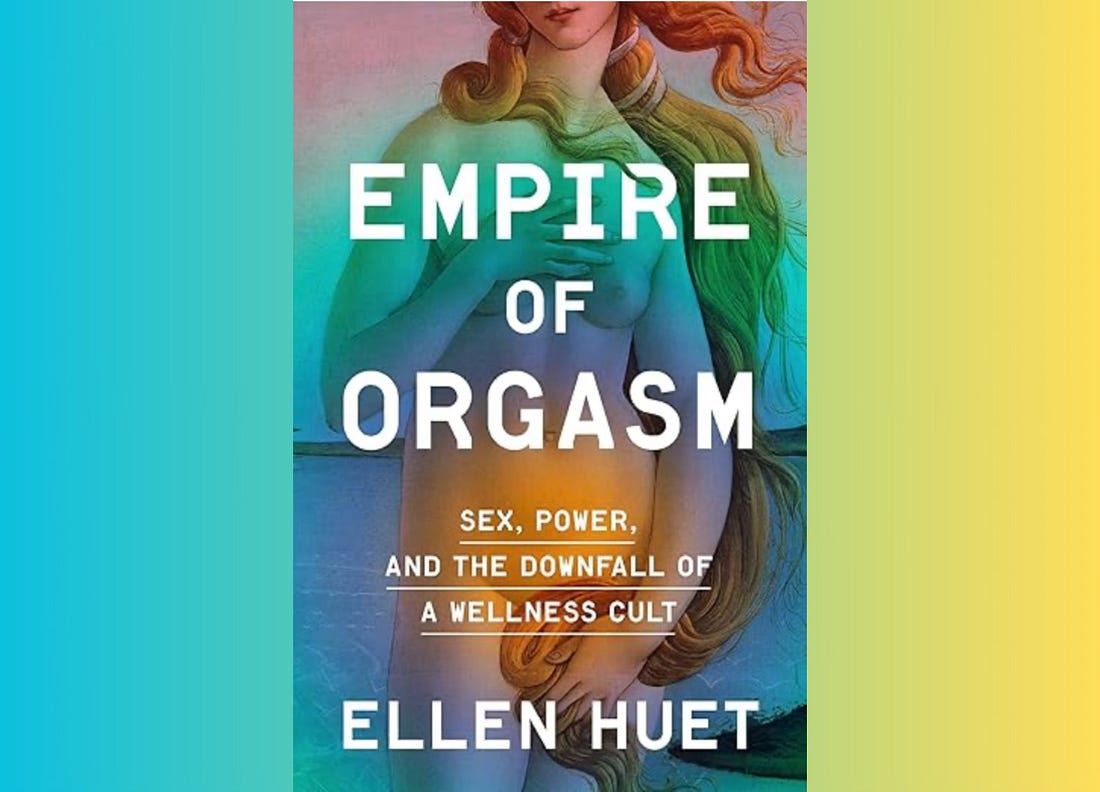
Orgasmic meditation was supposed to empower women. It was a 15-minute practice that involved a woman’s clitoris being stroked by a fully clothed man. The San Francisco-based company OneTaste and its charismatic leader Nicole Daedone promoted orgasmic meditation, or OMing for short, as a way for women to escape sexual shame, let go of the pressure to perform for men, and tune into the sensations in their own bodies. It could allegedly reawaken a woman’s sense of erotic power and turn her on—not just sexually but in the whole of her life. OMing was branded as a form of wellness—like an edgy version of doing yoga and drinking green juice—and it took off in the self-improvement boom of the late aughts. There was a splashy New York Times feature, a viral TED Talk, a book with a big-five publisher, and endorsements from Gwyneth Paltrow and Tim Ferris. Fast-forward a decade, though, and allegations of abuse and exploitation emerged. Soon, the FBI was investigating. This is the story told by Ellen Huet’s compassionate, morally grounded, and deeply researched book, Empire of Orgasm: Sex, Power, and the Downfall of a Wellness Cult, which came out this week. The book is the result of six years of investigative reporting and over 125 interviews. OneTaste members told Huet that the company “ruined them financially, coerced them sexually, caused unspeakable trauma in their lives, scrambled their minds, and suffocated their sense of self.” Huet also traces Daedone’s path from her childhood in Northern California to the Bay Area commune scene to being convicted this year on federal charges of forced labor conspiracy. Along that path, Daedone played many different roles: “acidhead, sex worker, student, teacher, guru, tormentor, monster, abuser, cult leader, victim,” Huet writes. This week, I was in conversation with Huet at Green Apple Books in San Francisco to celebrate the release of her book, and I recorded our conversation so that I could share it with you. We talked about everything from daily life at OneTaste’s San Francisco commune to Huet’s experience investigating alongside the FBI. Our conversation has been edited for clarity. In the late aughts, OneTaste had a retreat center and commune on Folsom Street here in San Francisco. What was daily life like for residents? Can you set the scene? When One Taste started, this was the mid-2000s, it was this loose group of people that was slowly getting more organized. Their central practice was orgasmic meditation, this 15-minute partnered meditative clitoral stroking practice, which purported to bring all sorts of benefits. Better sex, better relationships, better connection to your desire and your body, a connection to the spiritual and beyond. Their public face was selling courses on orgasmic meditation, but at the same time, they had this community aspect to the company, which was a little bit more on the interior. So if you became involved in OneTaste, you might start by taking classes, but those who became more involved might experience what you were talking about—daily life in one of these communal places. Their first communal residence was not so far from here in SOMA on Folsom Street. At first it was this big warehouse and then they ended up actually getting a former SRO that they then renovated as a residence. For those who are living there and really immersed in the OneTaste life, I think what really struck me in hearing stories about this is that it was fun. People talked about it feeling like being back in college—you know, maybe not the college that all of us experienced, to be clear. But daily life might look like waking up in this residence at 7 or 7:30 a.m. You would gather with your co-residents and do two sessions of orgasmic meditation. Okay, so, not like college—or if it was like college for you, come talk to me. This was their practice. So, imagine if you were, for example, living at an ashram or something. You would get up and you’d meditate in the morning. This is what they were doing. So you’d wake up, you’d do two rounds of orgasmic meditation, switching partners in between. You would do it with anyone, it’s not limited to partners you might have a romantic relationship with. Some people worked in the kitchen making communal meals for everyone. Other people worked on the sales team at OneTaste where their main work during the day was calling up sales leads and pitching them on buying the next OneTaste course. Sometimes all the residents would go and do Bikram yoga together, have another meal. In the afternoon, they would do two more rounds of orgasmic meditation. And then in the evening, they might prepare for a public event, like a night of communication games, which was how they tended to bring the public in to OneTaste to expose them to some of the ideas and practices of the group. In general, people talked about this time and they were like, “This was really fun.” It was like living with all your friends. It’s a lot of sex. There’s a lot of richness and exploration. And that’s something that I hope people take away from this is, you know, you might think that joining a group like this is, I don’t know, painful and unhappy, but it generally is not, and especially not at the beginning. I think it’s thrilling. Back in 2009, the New York Times published a feature on OneTaste and it catapulted Daedone and OneTaste into the mainstream. What was it about that particular time, culturally speaking, in the late aughts that allowed that to happen? And what was it, too, about this particular place, here in San Francisco that made for such a good launch pad? There’s a few things. First of all, San Francisco has always been a place of sexual experimentation. When people first heard about OneTaste back in 2009 in the New York Times, they were probably like, Oh, the San Franciscans are at it again. But that speaks to something real about what happens in the Bay Area. It’s a place where people like to experiment. I think goop launched in 2008, 2009, something like that. It’s the very beginning of the wellness industry boom, which is this commercial behemoth that comes out of nowhere, this idea that you might be paying for holistic wellness in the form of detoxes and classes and workshops. I think that was one of the major lifting forces that helped OneTaste get pretty close to the mainstream—it’s always gonna be a little bit off to the side because it’s so provocative. In the 2010s, remember how much excitement there was about the She-E-O, the girl boss? I hate those terms, but you know what I mean? In 2012, those were earnestly used. I think Nicole really rode that wave. Then, simply, the idea that the 2010s was an incredible time to be a startup founder in San Francisco. That was another thing that supported Nicole and OneTaste was that it was a fast-growing startup run by women about wellness. All these things coming together helped make this unusual practice feel like a real business. One of the things that was so interesting to learn in the book was that the practice of orgasmic meditation had actually originated earlier. You explain that it was called “deliberate orgasm” and that Nicole learned it at the Welcomed Consensus, which was a commune that you write about at length. In the book, you report on allegations that it was rife with sexism and also violence against women. Can you tell us a bit about those origins and how Daedone then rebranded this practice that she learned in this misogynistic context as a tool for… women’s liberation? There are these two predecessor groups that taught this practice called deliberate orgasm. It started in the late 60s at Morehouse, and they have this long complicated history, but it was essentially one of their practices, this meditative clitoral stroking practice. Then there was a spin-off group called the Welcomed Consensus. Nicole had, as far as I can tell from my reporting, more exposure to this spin-off group, but notably both of these groups taught this practice. It was not as structured as what we now know of as orgasmic meditation, and both groups were run by men. Neither of them was attempting to be a business. They sold courses in order to make money, but it was not their orientation to be spreading the word of this practice through commercialization. Nicole, as far as I can tell, was more immersed in the Welcomed Consensus, where the leader, according to many people I spoke to, was someone who showed lots of violence against women, and came up with philosophies that justified violence against women, and also would get drunk and hurt people. It was a seemingly pretty dark place. Based on everything I learned, it seems like Nicole saw promise and potential for something that could be bigger, and saw the potential to make her own version of it where she was the leader. That is pretty savvy, because it’s a practice that I think needs to be sold by a woman. It was a smarter marketing strategy. Most notably, she decided the way to spread the word about orgasmic meditation was by making it a business, which these other groups shied away from. They were not interested in trying to chase mainstream success in that way. You report that OneTaste used women’s sexuality to lure in customers. There was this implicit promise that by coming to a OneTaste event, men would get access to women’s bodies. I was so fascinated to learn that a lot of the men who visited OneTaste had started with pickup artist workshops and then moved on to OMing because they preferred a more “spiritual” approach. As a result, you write that women residents often felt “pressed to put their own bodies on the line,” essentially, to make a sale. It seems like there was this constant tension between selling women sexual empowerment, and selling men access to their bodies. How did residents make sense of that tension at the time? What would tend to happen is women who were residents in some of these early communal residences at OneTaste might be told, “We have a course happening this weekend and part of the course is going to involve doing the orgasmic meditation training. And so we’re going to need to have partners for some of the men who have signed up for the course and who don’t have a partner.” So it was socially expected of them to participate in that way—this is what was described to me. My guess is that they really believed in the mission of spreading orgasmic meditation to the world and that this was part of what it would take. They probably thought of it as philanthropic. Nicole has used the word “philanthropist” to describe herself. There was this sense that spreading orgasmic meditation to the world was going to heal people. And so if you really buy into that mission, you can imagine how you could rationalize, Okay, I’m doing it for the greater good. In addition to that, there were also principles and life philosophies that were propagated within OneTaste that might have also primed some of these people to say “yes” to something like that, which was, for example, the general idea that you would be gaining more in spiritual power if you could have sex with people outside of your preference zone. Right, what was it called, “aversion practice”? Yeah, that’s basically an example of one of the philosophies where they were like, “You can gain spiritual and sexual power if you are able to do things outside of your preferences or to do things that you have an aversion to.” Imagine how all these things weave together. It’s not just one thing, and it doesn’t happen overnight. If you have someone who has decided, like, “Yeah, I’m gonna adopt the philosophies of this group because I believe that they’re going to help me grow and they’re gonna bring me a better life, and I also believe in the mission of this company,” then you can imagine how they might get to the point where they’re like, “I will say yes to this ask in order to further the business’s growth.” And you can see in some cases how the asks got bigger and bigger over time, which brings me to the part of the story where you enter in. In 2018, you started working on a very consequential story on OneTaste. How did that article come about, and what did you find in your reporting? In 2017, I got an email. There’s lots of journalists in this room, we get many of these emails every day. In this case, I took a second look at this pitch, in part because I knew the publicist who had sent it to me, and she was basically saying, “You write about startups? I have this new client. It’s a fast-growing woman-led wellness startup called OneTaste. Maybe you’re interested in writing about them.” I ended up taking a meeting with the people who were running the company at the time, and they gave me the basic pitch. They called themselves “the Whole Foods of sexuality.” They’re like, “We’re the organic, good-for-you version of sexuality.” I wasn’t sure if I was gonna do a story and then I mentioned it to someone that I know and one thing led to another. I ended up getting in touch with someone who had been a previous customer and someone who was involved in OneTaste. They were like, “Actually, I had a pretty terrible experience. I feel like I was taken advantage of.” It just was my first clue that there was maybe something else to the story. It took many months, but then I found other people who had had similar experiences and then it expanded beyond what I first thought it was gonna be. That’s how I ended up writing that first story. At the time, of course, I didn’t know it was gonna lead to this. I didn’t know it was gonna lead to a criminal investigation. I believe it was shortly after your article published that OneTaste kind of went quiet for a time, and then you heard that the FBI was looking into it. What was it like to keep pulling thread on this story alongside the FBI? Well, it’s funny because they don’t want to talk to me and I’ve never managed to speak to them. The way that I even tracked the FBI investigation as it was evolving was that many of my sources who I’d spoken to for that first story would call me or text me and say, “The agents came by again yesterday.” Or like, “We talked for three hours,” or like, “This time they brought an Assistant U.S. Attorney.” I was like, “Oh, gosh, thanks, keep me updated.” For many years, that was the pattern. And I remember cold-calling one of the agents and he was like, “I can’t talk to you.” It was very devastating, and I think I tried a few more times and he was uninterested because I think it puts their work at risk. I just felt their shadow presence and then we never got to talk. I hope I get to talk to them someday. Maybe they’ll show up at one of your book events. How did the allegations against OneTaste and Daedone evolve from that first article of yours? It grew quite a bit. Thematically, there’s a lot of similarities, but one of the major things that I had no idea about when I wrote that first story was the setup that OneTaste had arranged in which their main financial backer was this venture capitalist who was also Nicole’s boyfriend at the time. There had been—according to many people who told me about this, and sworn testimony at trial—an arrangement in which he was provided with sexual favors for years, both these elaborate BDSM scenes for his birthday involving OneTaste employees, and they had arranged this system of sexual handlers for him. This series of women were asked to take on this special role in which they would typically live at his house or visit him very often, walk his dog, do grocery shopping, tidy up, and also give him, usually, a hand job every day, something like that. And this was a shadow system within OneTaste that kind of gets to the heart of what’s so complicated about this, because there are people who held the role of being handlers for this man who are still to this day some of OneTaste’s most loyal employees, they’re executives of the company, and I think they think that there was nothing wrong about that. And then there are also people who testified at trial and spoke to me at length who said that they felt that this was an extremely exploitative situation that they had been slowly taught a life philosophy, under a set of pressures, where they then felt like they said “yes,” but it was not a freely given yes. This is just really complicated—the whole book talks about the complication of agency under pressure. What is consent under pressure? Speaking of complexity and things that need to be handled very delicately, you write about Nicole being an alleged survivor of childhood sexual abuse. You draw a connection between that personal history and her attempt to turn sex and pleasure into something that is healing. How did you wrestle with these competing visions of Nicole as a victim and a perpetrator? This was one of the hardest parts of the book, understanding how to address what may or may not have happened between Nicole as a child and her father who, according to court records, was a convicted child sex abuser. She has spoken about how her father was not a frequent presence in her life. She was largely raised by her mom, but her father, she describes having a lot of love and adoration for him when she was a child. And she has at times spoken about how he had been convicted of abusing other children, but had often sidestepped the question of whether he had ever done something untoward to her. What I found was that people who knew her in her twenties told me that she had told them at times that her father had abused her. And then what’s more complicated is that later she reshaped the narrative of what that meant to her to be something in which she was an instigator or complicit in it in some way. You know, I’m not an expert on the subject, but in talking to experts, they would say that that is actually quite a common response, to find a framing that helps you find agency. What makes it even more complicated is that within OneTaste there is also a philosophy that seeing yourself as a victim was a lesser mindset, one that was small-minded or weak, and that to fall into “victim mindset” was largely seen as a derogatory thing. Instead you should be seeing your life as something in which you are one-hundred percent responsible for your experience, which is not a terrible idea on its own and can often be quite useful. But then it can also get taken too far. I just tried in the book to present all these sides of her in the hope that the reader would understand and come to their own conclusions about how one thing might have influenced the other. It is interesting that she adopted a mindset in which victimhood was kind of not an option. And I guess I’ll leave it at that. I think you do an amazing job of holding all of that in the book. So, it’s clear that for a lot of women, as you write, “OM was the first time they received pleasure without any pressure to reciprocate. They felt free, released of a burden that had weighed down every sexual interaction they’d ever had with another person.” It sounds like there were people who had very healthy and transformative experiences with OMing. Can OMing be disentangled from its allegedly abusive and toxic origins or are these things hopelessly entangled? One thing that’s hard is that I believe OneTaste has trademarked the term “orgasmic meditation,” so whatever you’re calling it, it would not be OM. But I would like to believe that that’s possible, but I haven’t seen it happen yet, or I haven’t seen it get traction. I do think that is one of the sorrows of this story. People who did study this practice deeply and who were really immersed in OneTaste, and who have left and felt like there was a lot of harm within that experience, nevertheless said to me that it was tragic to them that this practice never got the chance to live separate from the company that popularized it. They feel like there’s this wasted potential, that they do still believe in the principles of this practice—again, what you mentioned, this non-reciprocity, this idea that you could have a practice that’s structured radically around women receiving sexual pleasure with no expectation of reciprocity. It’s like. What? When else in life does that happen? It basically doesn’t. So I think they feel like there’s a lot of value in that and then it is lost because it is so closely tied with this company that they don’t stand by. I’m gonna squeeze in one last question. I know that you actually live in an intentional community here in the Bay Area. You also observe in the book that there are cult-like aspects to the tech scene that you cover as a journalist. I wonder if working on this book had a personal impact in terms of how you think of your own engagement with utopian dreaming and experiments with alternative ways of living—but also with how you, and all of us, brush up against all sorts of cult-like phenomena in daily life. At times when I’m at work and I have a story idea, I’m like, “Oh, there’s a cult angle.” I sometimes feel like that person who has the hammer—everything’s got a cult angle to it. That’s obviously not true. But it has been surprising to me to see cult dynamics show up in other things that I cover, like my colleague and I just wrote a big story about people who have experienced delusional spirals after using ChatGPT for many hours a day, and what that relationship is like when you have an intense emotional relationship with a chatbot that separates you from normal reality. It was so clear to me that there were cult parallels—having that relationship could isolate you from the other relationships in your life. It becomes your sole source of truth, at which point you ignore contradicting information and only trust ChatGPT. Part of what would bring you in, which is true across many cults, is this sense of wonder and access to special and previously unseen knowledge. There’s that emotional experience of feeling like you’ve discovered something special, which can be extremely emotionally alluring. So I do think that writing this book has opened my eyes to seeing not just what those cult dynamics look like in unexpected places, but it has also made me appreciate how much decisions that we make are a reflection of the social environment that we’re in. So many people who were in OneTaste talked to me about how all of a sudden, if you get very involved in this group, it becomes a very tight and insular social bubble that you live in, where all of your co-workers are in the same bubble as well as your lovers, your friends, your roommates. It’s all the same group of people, so all of a sudden the stakes feel very high for you to feel like you belong. They feel very high for you to feel like you are getting approval within a group, which as social creatures we all want. It was humbling to me to realize that the decisions we make are not really a reflection of our independent thoughts. They are so much a reflection of the approval of the people around us, the understanding that you would step up in status if you did action A versus lose status if you did action B. That’s much broader than just cults. Social behavior is a reflection of our environment. And if you’re in an unusual environment, you will make unusual choices.
|
četvrtak, 20. studenoga 2025.
The cult of s*xual empowerment




Pretplati se na:
Objavi komentare (Atom)
Counter-Algorithmic Relation Exercise #1: Learning with and from Boredom
I’d argue that befriending boredom would make many of us better friends and/or kin. I’d also argue that boredom helps us retain and recov...

-
Plus: Kicking off Pride Month with the new Goodnewspaper and more good news to celebrate! ...
-
Plus: A landmark ruling for new fossil fuel projects and more good news to celebrate! ...
-
And a job board for work in the food industry ͏ ͏ ͏ ͏ ͏ ͏ ͏ ͏ ͏ ͏ ͏ ͏ ͏ ͏ ...


Nema komentara:
Objavi komentar