As a therapist, I work with many people who are cut off from family members. Adult children who no longer talk to a parent. Parents who are desperate to get their kids to call back. Siblings who haven’t spoken in decades. Sometimes they’re all in the same meeting, which I consider an Olympic sport. “I don’t think about my daughter at all!” a woman once shouted at me. The emotional punch in her voice knocked me back in my chair, sending every thoughtful question I’d prepared scattering. Maybe she wasn’t thinking about her estranged daughter, but she was still reacting to her. I think this level of intensity, this sensitivity to the topic, shows up in our cultural conversations about estrangement. Parents or other relatives are portrayed as narcissists who won’t take responsibility for past actions. Young adults who go “no contact” are labeled as products of an overly individualistic society. Therapists are criticized as enablers, convincing their clients that small slights are actually abusive or toxic. When people bring these takes to the therapy room, I try to direct them towards science, which tells us that estrangement isn’t a moral failure or a personal victory, but a product of evolution. Ostracism is much older than humans. If a meerkat falls short on the job, his peers might stop feeding or grooming him. Dolphins who are too aggressive or uncooperative may lose their alliances. Wolves who challenge the authority of the alpha may end up hunting alone. Shaking off troublemakers maintains order and bolsters the social bonds of the group. If estrangement is automatic in nature, is it a smart move for humans, who have some capacity to observe and choose how we participate in relationships? Or are we fooling ourselves by thinking a decision to end contact is a choice at all? Humans are notorious for what neuroscientist Robert Sapolsky calls “a robust capacity for self-deception” when it comes to free will. The psychotherapy world tends to ignore our evolutionary heritage as social mammals, focused instead on human uniqueness and individual traits. When therapists flatten behaviors and serve them up as diagnostic identity, like “child of a narcissistic parent” or “insecurely attached,” we forget that people belong to larger living systems, which also must manage tension and function cooperatively. Our families are living systems that are constantly responding to stress in the environment and within the group. The more threats there are to a system, the more it tends to tighten up. Behaviors that defy social norms are more likely to be seen as threats. Dial down the stress, and we tend to be more tolerant and more open with our interactions. If the waters are calm in a family, tolerance may emerge when the favorite daughter marries someone from a different religion. If a topic like politics has already stirred up differences between siblings, they might stop speaking after they read their deceased mother’s will. In an age where our brains constantly react to local and global threats, it’s no shock that roughly 27% of American adults, 68 million people, reported being estranged from a close relative. There may have been a more recent evolution of values and normalization of estrangement, but to what degree are natural systems doing what they have always done when they face a threat? One must take the long view to answer this question. To capture the ebb and flow of stress, I draw a multigenerational family diagram with every therapy client. I ask questions like:
By looking at a multigenerational system’s responses to stress over time, with a bit of curiosity and neutrality, people can make more thoughtful choices about what to do with present dilemmas. Maybe that looks like reestablishing contact with a parent. Or reaching out to a long-lost aunt or cousin, fixing inherited estrangements. Sometimes people examine their intense focus on their own children, reducing the risk of future rifts. There are many ways to grow up, to introduce flexibility to a rigid system. When a client asks, Should I talk to my mom again?, I don’t have an answer I’m trying to steer them towards. Less of a determinist than Sapolsky, I’m curious how people’s choices can emerge from their best thinking, not their guilt or panic. Can they take the long view, seeing how the family system has tried to manage challenges and adapt to stress? Considering that a move they’ve labeled as a choice might be rooted in ancient, automatic forces much older than the pre-frontal cortex? Cutting people off can manage tension in the short term. It may even be the best choice for the long term. But sometimes it can constrain the resourcefulness in a family in a way that shows up in the next generation. The fewer contacts you have in the system, the fewer places there are for the tension to travel. That puts pressure on existing relationships, which can buckle under pressure. Figuring out how, when, and whether to engage challenging people is one of life’s big tasks. There are always going to be people in our families who bring out the emotional reactivity in us, but what we choose to do with it is an ongoing experiment. Similar posts:
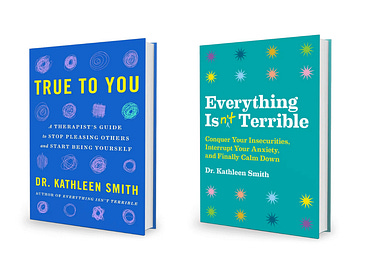
News from KathleenI’ll be back next week with a new Family Anxiety Thanksgiving Bingo board, so stay tuned! Buy my books True to You and Everything Isn’t Terrible for more in-depth stories of people working on their relationships and themselves. If you love them, consider giving them a review on Amazon so other folks can find them. If you haven’t gotten the free digital workbooks for them, email me.
Want to read more of my writing? Check out my newsletter archives. Paid subscribers can access the entire archive. Email me if you want me to speak to your group or are interested in doing coaching with me. Follow me on Linkedin, Facebook, or Instagram. You're currently a free subscriber to The Anxious Overachiever. For the full experience, upgrade your subscription.
|
utorak, 18. studenoga 2025.
Estrangement Is Older Than Our Hot Takes






Pretplati se na:
Objavi komentare (Atom)
5 Things to Say Instead of, "Have You Tried . . ."
The unnecessary solutions we offer others. ͏ ͏ ͏ ͏ ͏ ͏ ͏ ͏ ͏ ͏ ͏ ͏ ͏ ...

-
Plus: Kicking off Pride Month with the new Goodnewspaper and more good news to celebrate! ...
-
Plus: A landmark ruling for new fossil fuel projects and more good news to celebrate! ...
-
Plus, a roundup of links and fun finds from the week. ͏ ͏ ͏ ͏ ͏ ͏ ͏ ͏ ͏ ͏ ͏ ͏ ͏ ...


Nema komentara:
Objavi komentar